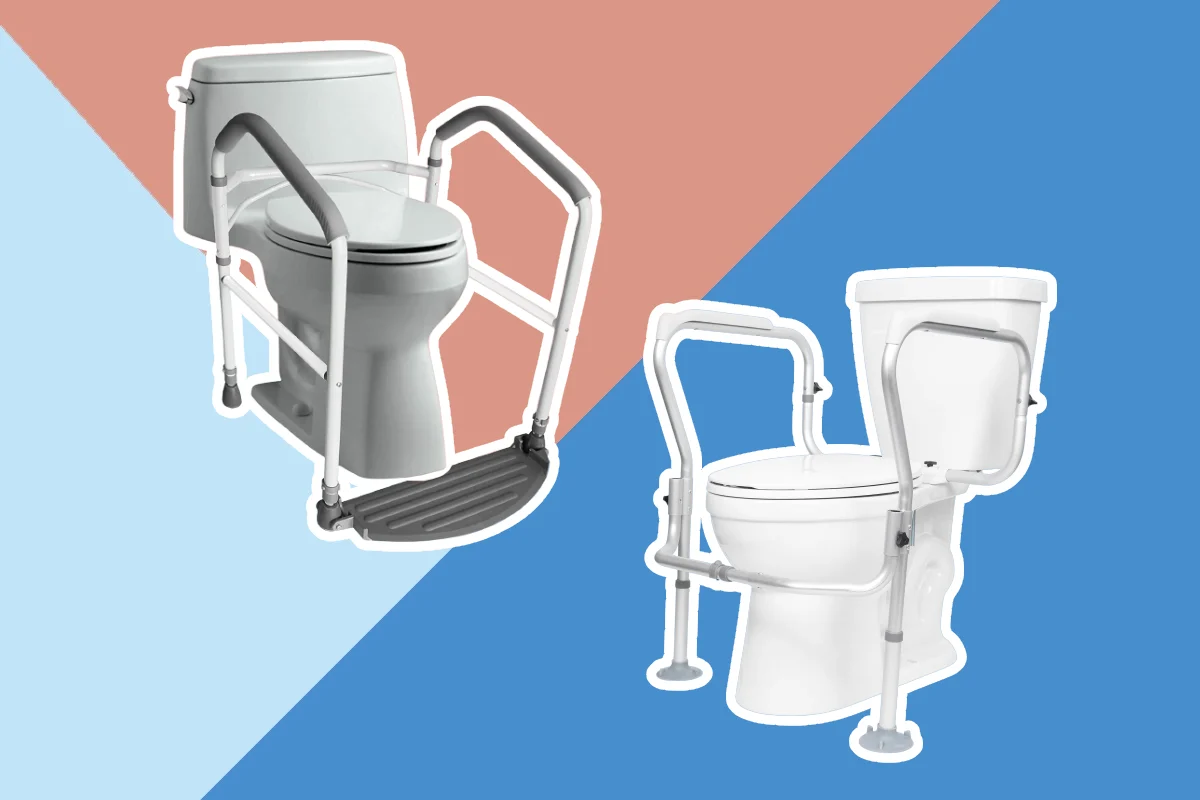
There are few things more important than safety in the bathroom, especially as we age and Toilet safety rails provide much-needed support or stability, allowing older adults to use the toilet with confidence and reducing fear of falling. For many of us, the bathroom is a place to relax and attend to personal needs. However, for seniors or anyone with mobility challenges, simply getting up and down from the toilet can be a source of anxiety and risk. Slips or difficulty rising from the toilet increase the chance of falls, and it’s no surprise that bathrooms rank high on the list of hazardous places for home injuries. Support rails dramatically reduce transition-related falls, which is why we highlight them in our central home fall prevention guide for seniors.
We explored the best toilet rails for seniors in 2025, including what’s new on the market, key features to look for (like adjustability and ADA compliance), and tips to ensure safe installation and use. Bathroom safety planning should always include knowing what to do after a fall in the shower to reduce injury risk. Our goal is to help you find a toilet assist rail that makes the bathroom safer, maintains independence, and gives peace of mind for both seniors and caregivers.
By Nan J.Corbo | ✅ Reviewed by Ray Butcher |
SeniorFitness is reader-supported. We may earn a commission through products purchased using links on this page. Learn more about our process here
TLDR; Toilet Rails for Seniors
Toilet safety rails are essential bathroom aids that help seniors and people with limited mobility use the toilet with stability and confidence. This 2025 updated guide covers the top toilet rails for seniors, highlighting freestanding frames, bolt-on rails, and combo raised seats that make sitting and standing safer. Key features to consider include sturdy weight capacity (250–300+ lbs), adjustable height and width to fit your toilet and body, comfortable padded handles, and easy tool-free installation. We also discuss ADA-compliant designs and new innovations like foldable portable rails for travel and decorative grab bars that blend with bathroom decor. In short, the best toilet assist rails prevent falls and promote independence by providing reliable support – all while meeting modern safety standards and user preferences in 2025.
Quick Summary
- Editor’s Choice: Vive Toilet Safety Rail Frame Best all-around freestanding rail. A height- and width-adjustable aluminum frame with padded, non-slip handles for a comfortable grip. It secures around the toilet (via the existing seat bolts) and features a stabilizing crossbar for extra support. Weight capacity: 300 lbs – sturdy enough for most users. (Ideal for those wanting a reliable, easy-to-install rail that fits almost any bathroom.)
- Best Heavy Duty: KMINA Toilet Safety Rails Highest weight capacity. This steel-framed rail supports up to 300 lbs and includes two front stability legs in addition to the handles. It’s designed for individuals of all sizes who need extra support. Despite the heavy-duty build, it’s height-adjustable and fits around standard toilets. (Great choice for bariatric users or anyone seeking maximum stability.)
- Best Folding: RMS Toilet Safety Frame & Rail Most portable design. A standalone frame that arrives fully assembled and folds out for use. The frame is wider and more stable than many bolt-on styles, and it’s easy to tuck away or travel with when needed. (Perfect for those in smaller spaces or who may move the rail between bathrooms.)
- Best for Elderly: Carex Toilet Safety Rails Extra-support legs for stability. This bolt-on style rail attaches under the toilet seat and has two additional legs that rest on the floor. The front legs provide added strength and stability, so the rail feels firm even for users with very limited strength. (A top pick for frail seniors who need confidence that the rails won’t wobble.)
- Best Value: Moen Toilet Safety Bar Rails Discrete and budget-friendly. These rails feature a simple armrest style that bolts onto the toilet (no front legs). Made by a reputable brand in bath safety, the Moen rails support up to 250 lbs and have a stable, ergonomic design. They lack some bells and whistles but are solid and often less expensive — a good solution for those on a budget who still want quality and ADA-compliant support.
- Best Portable: RMS Raised Toilet Seat Seat riser + rails 2-in-1. This is essentially an elevated toilet seat that includes built-in armrest rails. It’s a fantastic portable option because it requires no installation — you simply set it on top of the existing toilet bowl. By raising the seat height and providing handles, it greatly eases the strain of sitting and standing. (Recommended for short-term needs, post-surgery recovery, or travel, as it can be removed or relocated in seconds.)
Top 6 Toilet Safety Rails Review 2025
1. Editor’s Choice for Toilet Rails for Seniors
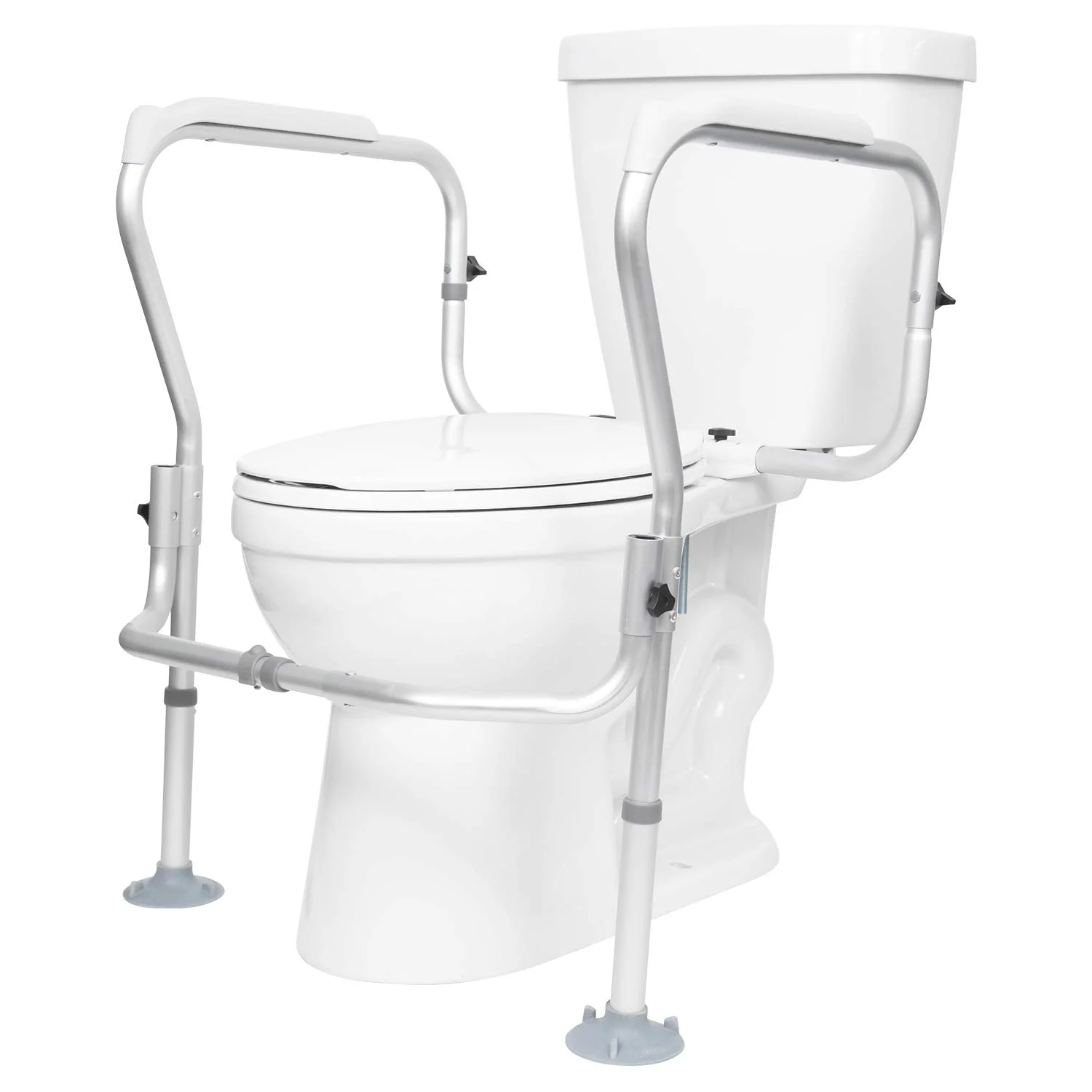
Vive Toilet Safety Rail Frame
Features
- Type: standalone frame
- Material: aluminum
- Dimensions: 25 x 19.3 x 4.2 in
- Weight capacity: 300 lbs.
More features: padded nonslip handles
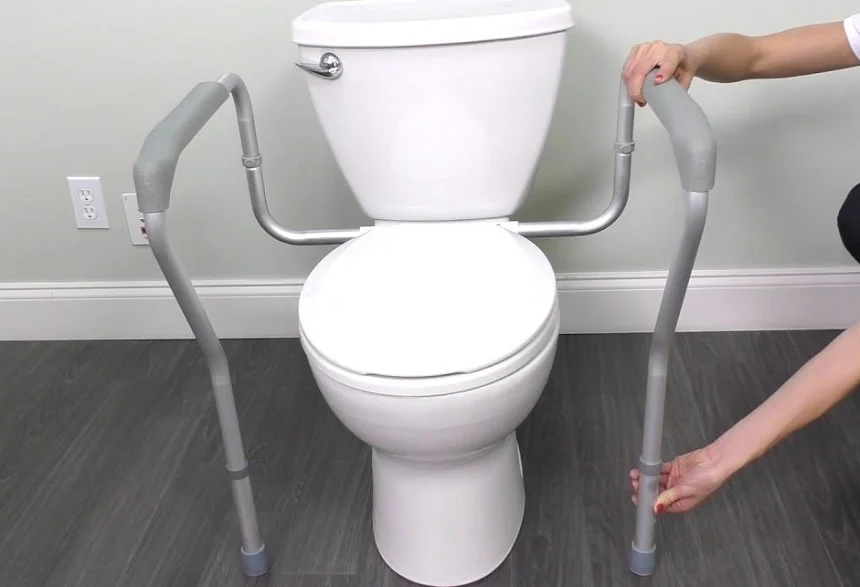
The Vive toilet safety rail is our top pick as it provides a safe and secure grip for individuals who need assistance in sitting or standing. The padded, nonslip handles fit comfortably in your hand while the stabilizing bar between the handles offers added support. The height- and width-adjustable design makes this toilet safety rail perfect for any bathroom, while the easy installation means you’ll be up and running in no time. With a weight capacity of 300 lbs., the Vive toilet safety rail is the best way to stay safe and independent in your own home.
The Vive Toilet Safety Rail Frame is a top choice for anyone looking for a Toilet Safety Rail that’s a standalone frame. It’s made by the reputable Vive Health, a brand that prioritizes safety and maintains high repute in churning out highly durable household items. This Vive Toilet Safety Rail Frame will undoubtedly serve a family home more efficiently and conveniently.
What stands out?
- Secures directly to the toilet behind the seat.
- Has a stabilizing bar between the handles in the front of the rails.
- Simple put together and install, very straight forward.
- The handles are width adjustable (21.5 to 26.5 in), and height-adjustable (26 to 31.5 in).
What cons did we manage to find?
- The suction cups would not work as well on a not completely flat floor.
2. Best Heavy Duty Toilet Safety Rails for Seniors
Amazon
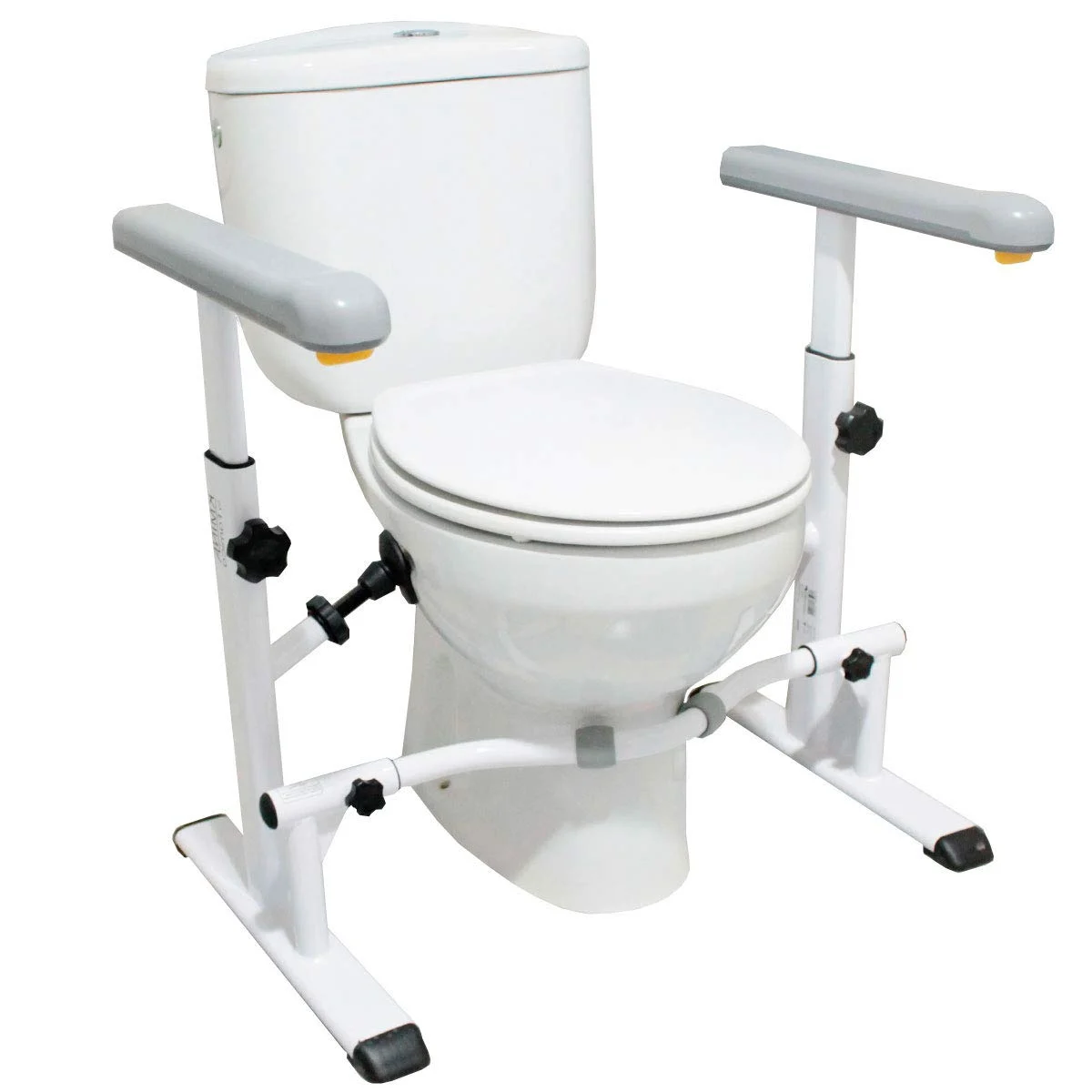
KMINA Toilet Safety Rails
Features
- Type: standalone frame
- Material: steel
- Dimensions: 20 x 19.96 x 5.79 in
- Weight capacity: 300 lbs.
More features: adjustable in 3 dimensions and adaptable to any type of toilet
KMINA Toilet Safety Rails give you the support and stability you need to complete your daily bathroom routine with ease. With a weight capacity of 300 lbs., this essential bathroom safety tool can be used by individuals of all ages and sizes. The frame is made of steel for maximum durability, and the three-dimensional design is adjustable to fit any type of toilet. The KMINA Toilet Safety Rail is easy to assemble and provides a sturdy support for sitting down and getting back up from the toilet. This product is an essential for any home bathroom and is sure to provide you with the peace of mind and independence you need to live your life to the fullest.
The KMINA Toilet Safety Rails features a standalone frame like the Vive Toilet Safety Rail Frame. They are also both adjustable and can be adjusted to suit your preference. However, if you look for more in design, you’ll find this KMINA Toilet Safety Rails more appealing. And if you prefer steel to aluminum, the KMINA Toilet Safety Rails offers that.
Why are we impressed?
- It is super sturdy, does not shake.
- It is easy to put together, sturdy when you’re sitting and sturdier when you are getting up.
- It’s well worth the money.
- Plenty of space to move, and it supports to sit down and back up.
What negatives must you be aware of?
- It’s not created for very small spaces.
3. Best Folding Safety Rails for Seniors
Amazon
RMS Toilet Safety Frame & Rail
Features
- Type: folding frame
- Material: aluminum
- Dimensions: 25 x 20 x 28 in
- Weight capacity: 300 lbs.
More features: folding and portable
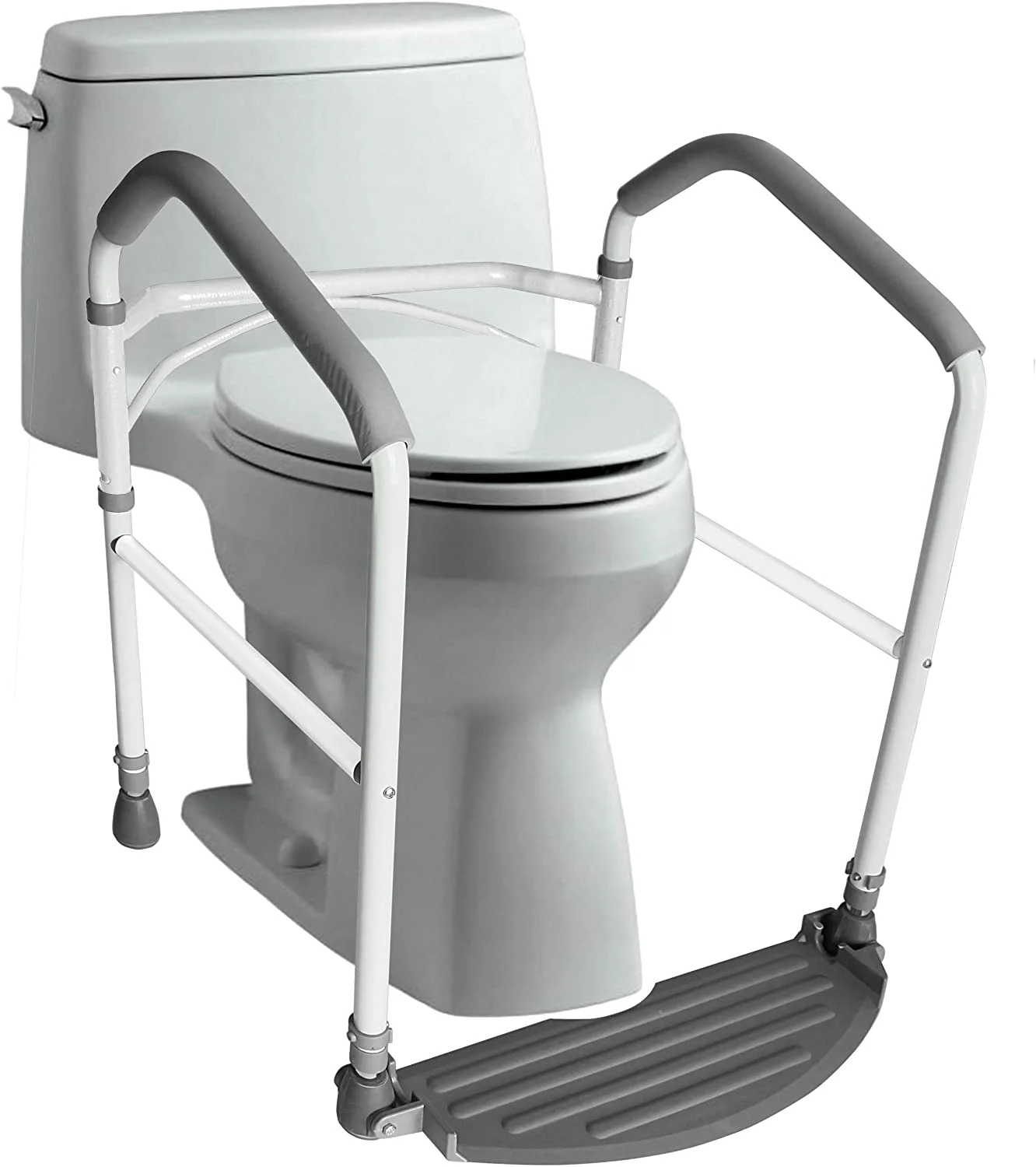
The RMS Toilet Safety Frame & Rail is the best folding toilet safety rail on the market. This tough and durable frame is made from aluminum and can support up to 300 lbs, making it perfect for those who need a little extra support when using the toilet. The frame is more stable than the bolt-on style and arrives folded and completely assembled so you can start using it right away. The height of the arms is adjustable, and the footrest at the front provides more stability when rising off the toilet seat. Plus, its folding design means it’s easy to take with you when you travel.
The RMS Toilet Safety Frame & Rail matches the Vive Toilet Safety Rail Frame in terms of being made with aluminum and also supports the same weight capacity of 300 lbs. But if you prefer a folding frame to a standalone frame, you should go for it. And more interestingly, it has a rating of 5.0 for being “easy to install.”
What makes it special?
- The frame is more stable than the bolt on style.
- Arrives folded and completely assembled.
- The height of the arms is adjustable.
- The footrest at the front provides more stability when rising off the toilet seat.
What cons did we find?
- Might be too narrow for some users.
4. Best Toilet Safety Rails for Elderly Seniors
Amazon
Carex Toilet Safety Rails
Features
- Type: standalone frame
- Material: not stated
- Dimensions: 17.5 x 20.5 x 31.5 in
- Weight capacity: 300 lbs.
More features: handle width is adjustable from 18 to 20 in
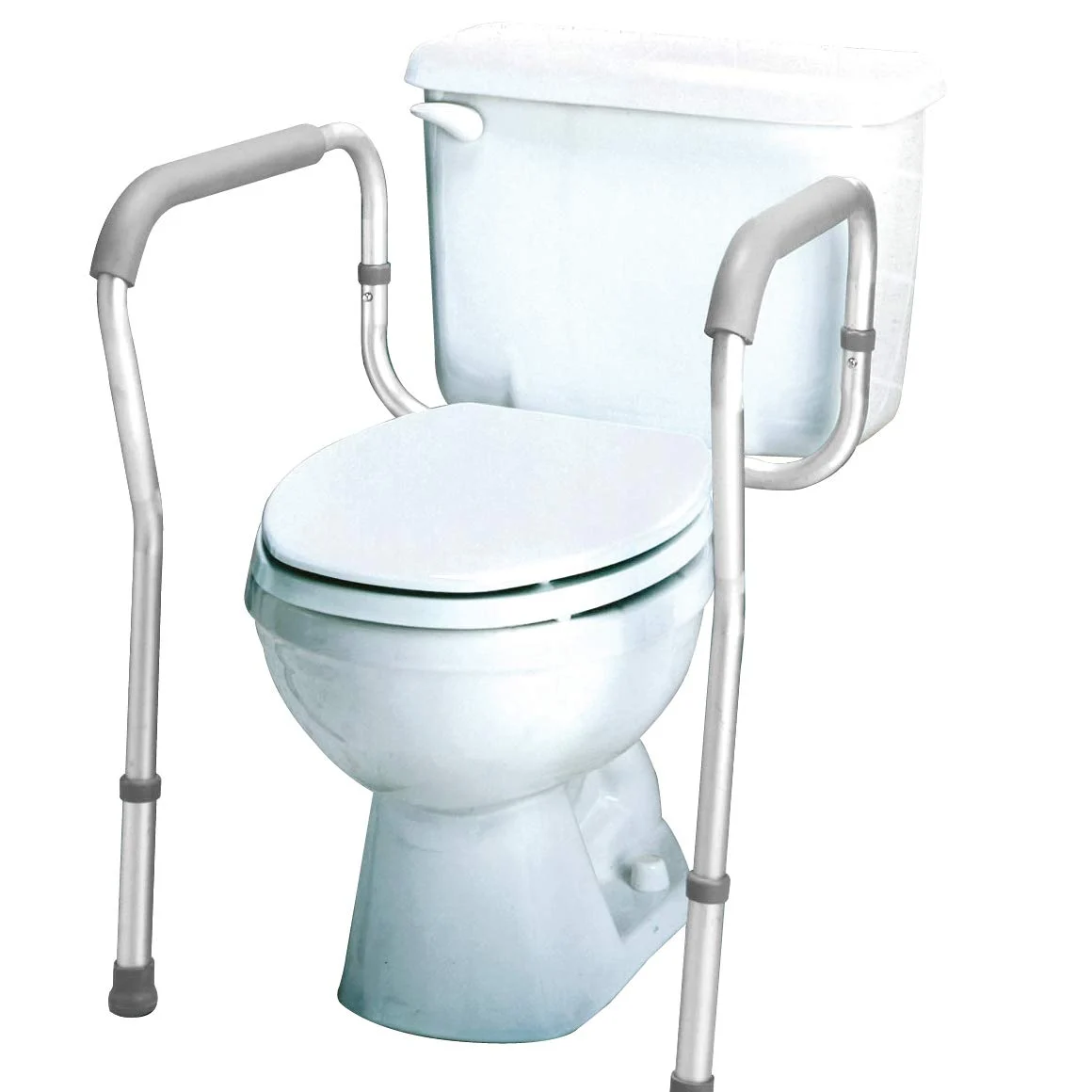
The Carex Toilet Safety Rail is a reliable and sturdy frame that is perfect for those who need a little extra support when using the bathroom. With its adjustable handle width, this rail can accommodate anyone from 18 to 20 inches wide, making it a great option for a variety of users. Additionally, the two front legs add extra strength and stability to the frame, ensuring that you’ll feel safe and secure when using it. Thanks to its quick and easy installation, you’ll be able to get this toilet safety rail up and running in no time at all – giving you the peace of mind and independence you need in the bathroom.
The Carex Toilet Safety Rails joins the company of Vive Toilet Safety Rail Frame and KMINA Toilet Safety Rails, which have a standalone frame. While it doesn’t have wider dimensions like the other two, it’s safe and excellent for the disabled, the handicapped, and the elderly. If you have anyone who may be at risk of falling, this Carex Rails can come in to save the day.
What are its best features?
- Secure and could be quickly installed.
- This product works well in the limited space.
- The rail is flexible but holds up well when weight is put on it.
- Front two legs add in the strength (as opposed to one that has handles that ajust under toilet seat).
What could be improved?
- These safety rails are not the sturdiest.
5. Best Value Toilet Safety Rails for Seniors
Amazon
Moen Toilet Safety Bar Rails
Features
- Type: transitional
- Material: aluminum
- Dimensions: 21.9 x 9.2 x 4.1 in
- Weight capacity: 250 lbs.
More features: lifetime limited warranty
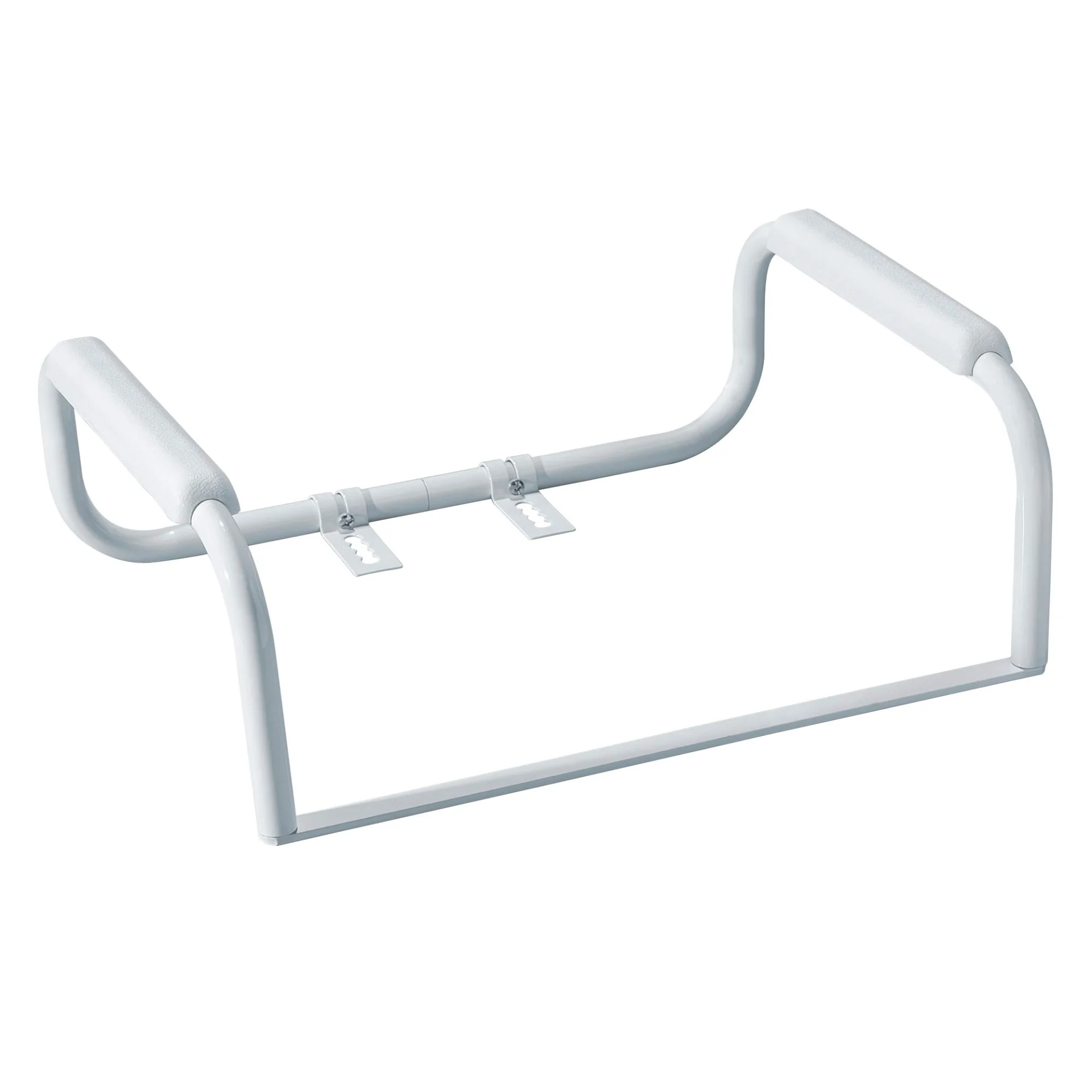
The Moen Toilet Safety Bar Rails are the perfect way to keep your bathroom safe and accessible for an affordable price. These safety bar rails are made of aluminum for durability, and they feature a transitional design that will look great in any bathroom. With a weight capacity of 250 pounds, these bar rails are very stable, much more so than similar products with wobbly legs. Assembling and installing the Moen Toilet Safety Bar Assembly is very straightforward. Plus, the front crossbar is very heavy-duty, giving you extra reassurance when using it. Best of all, the Moen Toilet Safety Bar Rails come with a lifetime limited warranty, so you can be confident that you’re making a wise investment.
The Moen Toilet Safety Bar Rails is a unique option on this list. It has a very simple design and features a transitional type. More so, it’s the only toilet safety rail on this list that supports the least weight capacity, which is 250 lbs. And, it may be the finest option for individuals who seek something quite simple and not too heavy.
What are its best features?
- Very stable, much more so than similar products with wobbly legs.
- Assembling and installing is all very simple and very straightforward.
- The front cross bar is very heavy duty.
What could be improved?
- Not suitable on elongated toilet bowl.
6. Best Portable Safety Rails for Seniors
Amazon
RMS Raised Toilet Seat
Features
- Type: portable
- Material: composite
- Dimensions: 17.5 x 17 x 9 in
- Weight capacity: 300 lbs.
More features: the width of the handles can be expanded, soft padded foam handles
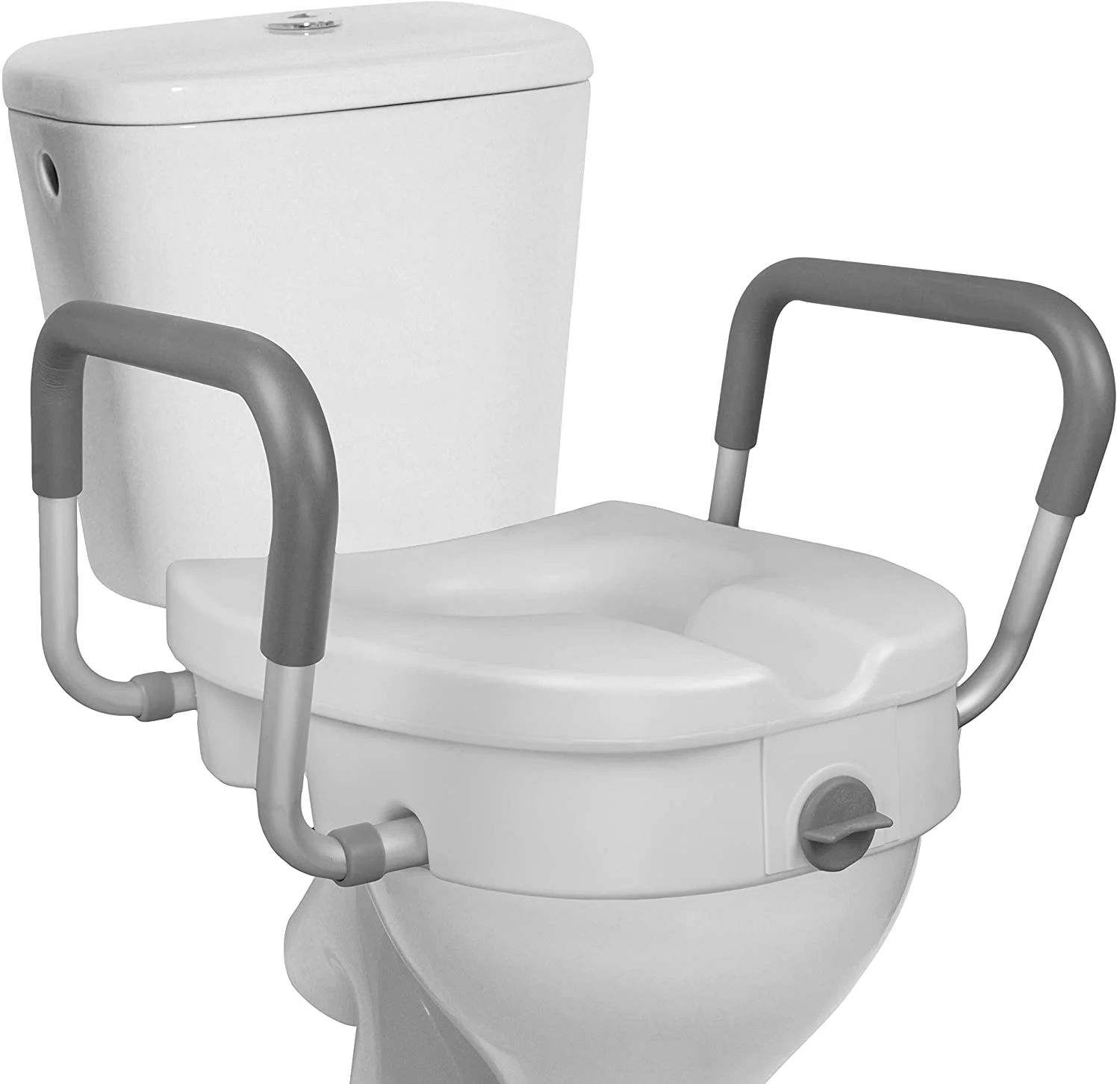
The RMS Raised Toilet Seat is the best portable seat with rails on the market. It is made from a composite material that is lightweight yet very sturdy. It has a weight capacity of 300 lbs. and can be easily installed and removed for cleaning. The soft padded foam handles provide a comfortable grip and the width of the handles can be expanded to accommodate different users. This seat is a great solution for anyone who needs a little extra assistance when using the toilet. Elevated toilet seat and the handles are very helpful for those who have difficulty getting up and down.
The RMS Raised the manufacturer also makes Toilet Seat of the RMS Toilet Safety Frame & Rail. These two siblings share a few things in common, like portability, padded foam arms, easy installation, and 300 lbs. capacity. However, this RMS Raised Toilet Seat has extra features missing in the RMS Toilet Safety Frame, like the adjustable width and additional 5″ in height.
What are its best features?
- Easy to install and easy to remove for cleaning.
- This design cleverly solves the stability issue and the mounting is rock solid.
- Elevated toilet seat and the handles are very helpful.
What could be improved?
- Will take a little getting used to.
Buying Guide
Not all toilet safety rails are created equal. When evaluating options, it’s crucial to consider the senior’s specific needs and the bathroom’s setup. Here are the key factors and features (updated for 2025) to keep in mind:
Types of Toilet Safety Rails
There are several different types of toilet safety rails on the market, each designed to meet the needs of a different customer. Standalone frame rails are the most common type, and they can be installed permanently or semi-permanently to the bathroom wall. These rails provide a sturdy support for those who need assistance getting on and off the toilet. Portable rails are another popular option, as they can be moved from one bathroom to another as needed. These rails are often used by elderly patients who require extra support when using the restroom. Finally, folding toilet safety rails are designed for easy storage, and they can be a good choice for small bathrooms where space is at a premium. No matter what your needs, there is sure to be a type of toilet safety rail that is perfect for you.
- Freestanding Frames: These are standalone rail units that do not attach directly to the toilet. They typically have a U-shaped frame that surrounds the toilet and rubber-tipped legs that sit on the floor for support. The user essentially has a walker-like frame around the toilet. Pro: Easy to install (just position it) and usually height-adjustable. Con: Takes up a bit more floor space. Great for renters or if you don’t want to modify the toilet itself.
- Bolt-On Rails: These models attach to the toilet itself, usually by using the toilet seat’s mounting bolts. They often have arms that come up on either side of the seat, and sometimes include legs that reach the floor (for added stability). These feel very secure because they’re anchored to the toilet, and they save space. However, installing them may require a little effort (removing the seat, etc.). The popular Carex rails, for example, bolt on and have extra support legs for stability.
- Wall-Mounted Flip-Up Rails: Common in ADA-compliant bathrooms, these rails are fixed to the wall next to the toilet. They can flip up out of the way when not in use. These are extremely sturdy if installed into wall studs, and they don’t clutter the floor. They are ideal for long-term or permanent needs, but installation is more involved (drilling into the wall) and usually requires a professional or someone handy. They effectively act as a robust grab bar that you can push down on when standing.
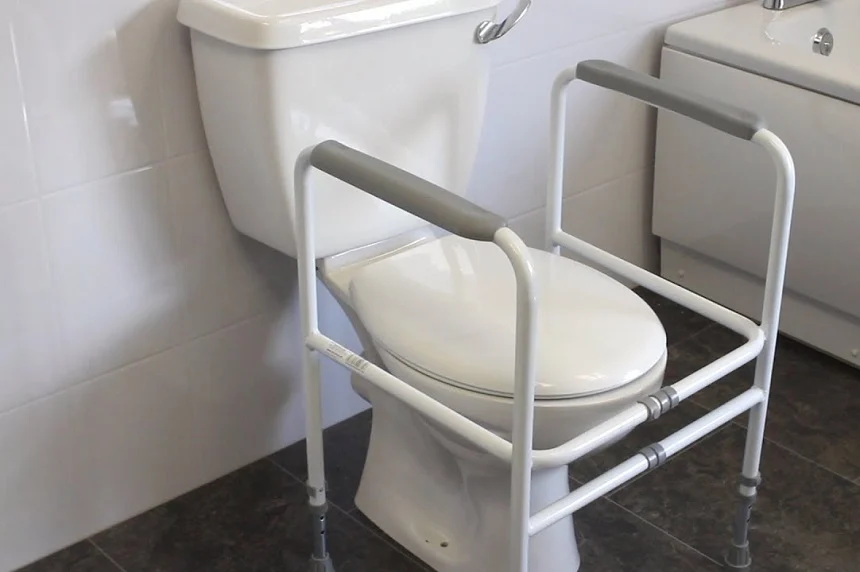
Tip: Consider the bathroom layout and whether a permanent installation is okay. Freestanding and clamp-on models are best for adaptability, while wall-mounted bars are excellent for dedicated accessibility retrofits.
- Raised Toilet Seats with Arms: This is a hybrid solution; a raised plastic toilet seat (adds height, often 3–5 inches) that includes integrated armrest rails. It’s an excellent option for someone who also benefits from a higher seat (for example, after hip surgery or if bending is hard) in addition to arm support. Many of these simply clamp onto or replace the existing seat, making installation tool-free. They are portable and can be removed for cleaning or travel. The RMS Raised Toilet Seat is one such example, combining a 5” lift with sturdy handles for support.
- Travel/Foldable Rails: Newer designs cater to portability, some rails are lightweight and foldable so seniors can bring them on trips or move between bathrooms. For instance, the OasisSpace and RMS standalone frames can fold flat or be easily disassembled, enabling use in a hotel or a family member’s home. If you’re frequently on the go, look for “folding” or “travel-friendly” in the product description.
- Heavy-Duty Bariatric Rails: If the user is on the higher end of the weight spectrum or just wants extra peace of mind, heavy-duty rails are available. These might be a beefed-up version of freestanding or bolt-on frames, using thicker steel tubing and often supporting 350 lbs or more. They may be a bit bulkier, but safety comes first. A heavy-duty rail can be the difference that allows a person to confidently use the toilet without assistance.
Height and Width Adjustability of Toilet Rails for Seniors
Proper fit is crucial for comfort and leverage. A rail that is too low or too narrow can be just as problematic as not having one. Here’s what to consider:
Depth and Clearance: Also think about how far forward the rails extend. Will there be enough room for the user’s thighs when sitting? Rails with an open front (nothing connecting the handles at the front) provide more leg clearance, but those with a front bar add stability. Measure from the back of the toilet to any obstacles in front (like a vanity) to be sure the frame’s legs will fit.
Rail Height: Most toilet seats are around 16–17 inches from the floor (standard chair height), whereas a comfort height or ADA-compliant toilet is 17–19 inches high. The ideal rail height will be a few inches above the seat – typically rails range from about 26″ to 31″ off the floor. Many products offer height-adjustable legs to tailor this. For example, adjustable models might list a range (e.g., “handles adjust from 26″ to 31.5″ in height”). Set it so that when the user’s hands rest on the grips, their elbows have a slight bend (around 30 degrees); this allows them to push down effectively to stand.
Rail Width: The space between the two arm handles should accommodate the user comfortably. Standard toilets are roughly 14–16 inches wide at the bowl, and most rails are made to straddle that. Many adjustable-width rails can expand from about 20″ up to 25″ or more. If the rail is freestanding, ensure it’s a bit wider than the toilet bowl so it doesn’t pinch the user’s hips. If it’s a bolt-on style, check that it fits your toilet’s shape (round vs elongated bowls can affect available space for the rail arms). Most product specs will say “fits most standard toilets” – for example, the Vive bolt-on model adjusts 21.5″ to 26.5″ width to accommodate different toilets.
Being able to adjust height and width is especially important if multiple people will use the rail (for instance, in a senior care facility or if both parents might use it). An adjustable model ensures a custom fit for each user’s build.
Materials
Firstly, the rails should be made of a sturdy material that can support the weight of an individual. Secondly, the material should be easy to clean and disinfect. Finally, the material should be non-slip to prevent accidents. Based on these criteria, stainless steel is often considered to be the best material for toilet safety rails. It is strong and durable, and can easily be cleaned and disinfected. Additionally, stainless steel has a smooth, non-porous surface that is less likely to harbor bacteria. As a result, it is an ideal material for toilet safety rails.
Weight Capacity
Always check the weight capacity of a toilet rail to ensure it can safely support the user. Most standard toilet safety frames support around 250 pounds, which covers the average user. However, if you need more support:
- Look for rails rated for 300 lbs or higher. Many of our top picks, like the Vive and KMINA, have a 300 lb capacity to accommodate a wide range of individuals.
- Bariatric models can support 350–400+ lbs. These heavy-duty rails use stronger materials and often have additional legs or cross-bracing for stabilitymoovkart.com. They are slightly more expensive on average, but crucial for safety if the user’s weight is near or above the standard rail limits.
- Keep in mind that even if a person’s weight is below the limit, they might put a lot of force on the rails when pushing up. Having a buffer (for example, a 300 lb-rated rail for a 220 lb person) can add durability and stability.
Stability isn’t just about weight capacity. Design features matter too:
User technique: Encourage users to push straight down on the rails rather than yanking to the side. A well-made rail will handle some side pressure, but straight downward force (like a push-up motion) is safest and least likely to make anything shift.
Floor contact points: Freestanding rails usually have four feet on the floor; models with more floor contact (or suction cup feet) can feel more secure. If the rail has no legs (just attaches to the toilet), ensure the attachment mechanism is robust and doesn’t wobble.
Cross-bars and reinforcement: Rails that have a connecting bar in front of the toilet (joining the two arms) or behind the toilet seat tend to be more rigid and won’t splay outward under pressure. The Vive frame, for instance, has a stabilizing bar in front for this reason.
Comfort and Ergonomics
A toilet rail is something a senior might use several times a day, every day, so comfort matters:
Appearance: While not “comfort” physically, emotional comfort is a factor too. Seniors often prefer equipment that looks less medical. Fortunately, manufacturers now offer less clinical designs. You can find rails in white, gray, or chrome that blend in. As one caregiver noted, there are even decorative grab bars available so the home doesn’t feel like a hospital. Feeling at ease with how a device looks can encourage consistent use.
Padded Armrests: As mentioned, padding can relieve pressure on the palms – crucial for those with arthritis or frail hands. It also insulates against cold (a metal rail can feel chilly in winter). High-density foam that doesn’t flatten out over time is ideal. Ensure the padding is securely attached; you don’t want sleeves that slide around.
Ergonomic Shape: Some rails curve slightly inward or have a contour where the hand naturally goes. This can make it easier to get a firm grip. A few models even have angled handles that help users with a weaker grip to still push effectively. Test out a rail if possible, or look closely at product photos to see if the handle shape looks comfortable.
Non-Slip Features: Beyond the hand grips, look at the rail’s feet (for freestanding) – rubber tips are standard, and they should make full contact with the floor. Suction-style feet can add stability on tile floors if included. The goal is to prevent any sliding of the frame.
Balance Aids: If a rail includes a crossbar or additional midpoint bar, check that it doesn’t interfere with the user’s legs. Ideally, it’s low enough or far enough forward to not hit the shins. Some products add a horizontal bar that can double as a footrest or simply a reinforcement – make sure it’s an asset, not a discomfort.
Adjustability
Most toilet safety rails on the market are adjustable, which is extremely beneficial for those who may have difficulty using the restroom. The ability to adjust the height of the rails allows users to find the perfect position for themselves, ensuring that they can safely and comfortably use the restroom. Additionally, adjustable rails can be used by people of different heights, making them a more versatile product. While many toilet safety rails are made of metal, some models also feature padded armrests for added comfort. Padded armrests can make it easier for users to get up and down from the toilet, as well as provide a soft surface to grip when using the restroom.
Extra Features
Most toilet safety rails have several features that make them both functional and comfortable. For example, many models have padded armrests to provide a soft place to grip when getting on and off the toilet. In addition, most models have adjustable legs that can be set to the perfect height for each individual user. This ensures that the user will be able to get a good grip on the arms while still being able to sit down and stand up with ease. Finally, many toilet safety rails also have an attached raised seat, which can make it easier for those with mobility issues to use the toilet without assistance. By taking these factors into account, it is easy to see why toilet safety rails are an essential bathroom accessory for many people.
Installation Tips for Toilet Rails
Toilet safety rails provide support and stability for seniors and people with disabilities when using the toilet. Most models are easy to install and can be done in just a few minutes with basic tools. Here’s how to install toilet safety rails in your home:
- Choose the location for the rails. Most models come with two brackets that can be installed on either side of the toilet bowl.
- Mark the holes for the brackets. Use a pencil to mark the four holes that will be used to attach the brackets.
- Drill pilot holes. Use a drill to create pilot holes at the marked locations.
- Attach the brackets. Screw the brackets into place using the provided hardware.
- Snap on the rails. Most models of toilet safety rails come with two rails that snap onto the brackets.
If you have portable rails, here’s how to install portable toilet safety rails:
- Choose the location for the rails. Most portable models come with two suction cups that can be attached to either side of the toilet bowl.
- Attach the suction cups. Press the suction cups firmly into place.
- Snap on the rails.
That’s all there is to it! Toilet safety rails provide a valuable addition to any bathroom, and can help keep everyone in your home safe.
Toilet Rails for Seniors FAQ
Q1: Who should consider using toilet safety rails?
A1: Toilet safety rails are recommended for anyone with limited mobility, strength, or balance who struggles with using a standard toilet. This includes many seniors, people with disabilities, those recovering from surgery or injuries, and individuals with conditions like arthritis that make standing or sitting difficult. Even if a person can use the toilet unaided, rails can provide added confidence and fall prevention – they’re a proactive safety measure. Essentially, if getting on or off the toilet causes the person worry or requires a lot of effort, safety rails can help. They are also useful for individuals with vision impairments (providing a tactile guide) or anyone prone to dizziness upon standing. It’s about maintaining independence: rails reduce the need for a helper during bathroom trips, preserving privacy and dignity for seniors.
Q2: How do I install toilet safety rails? Are they easy to set up?
A2: Installation depends on the type of rail, but most are designed to be user-friendly. Freestanding rails and clamp-on rails often require no tools – you just assemble a few pieces and place or attach the rail around the toilet. Models that attach via the toilet’s seat bolts might need a screwdriver or wrench, but they typically use the existing holes on the toilet, so there’s no drilling into porcelain. Wall-mounted grab bars are the most involved to install (drilling into the wall and hitting studs is important for safety). In general, if you’re comfortable with basic DIY tasks, you can install most toilet rails yourself in under 15-30 minutes. Many brands provide step-by-step instructions or even video tutorials. If a model advertises “tool-free assembly” or “universal fit,” it’s likely on the easier end. For more detailed guidance, see the Installation Tips section above in this article, where we break down steps for various rail types. And remember, if in doubt, seek help from a professional or a savvy friend – safety first!
Q3: Do toilet safety rails fit all types of toilets (round, elongated, one-piece, etc.)?
A3: Most toilet safety rails are designed with adjustability or a universal mounting method to fit almost any standard toilet. Freestanding frames are generally size-agnostic – they straddle the toilet regardless of bowl shape. Bolt-on rails usually have some adjustable width or multiple hole positions to accommodate both round and elongated toilets (elongated bowls are a bit longer in front, but the distance between mounting holes is standard). For example, many products say “fits most standard toilets” and can adjust width from about 18″ up to 24″ or more. One-piece toilets (where the tank and bowl are fused) sometimes have less space under the seat hinge area – in such cases, clamp-on rails might not work if there’s a lip or unusual shape. It’s always a good idea to check the product specifications: look for notes like “not compatible with decorative skirted one-piece toilets” if any. But those instances are rare. In summary, yes, the vast majority of toilet rails will fit common two-piece toilets and many one-piece designs. Always measure your toilet’s dimensions and compare with the rail’s required clearance just to be sure.
Q4: What is the typical weight limit for toilet rails? Do they support heavier individuals (bariatric users)?
A4: Most standard toilet safety rails have a weight capacity around 250 lbs (113 kg). This covers a large portion of users. However, many newer models have increased capacity to 300 lbs (136 kg) to add a safety margin. For example, our Editor’s Choice Vive frame and several others we mentioned support 300 lbs. For bariatric needs or users over that range, there are heavy-duty rails rated for 350, 400, even up to 500 lbs in some cases. These heavy-duty versions use thicker steel tubing, additional leg supports, and wider frames to distribute weight. Always choose a rail that exceeds the user’s body weight – if someone is 240 lbs, a 250 lb-rated rail is technically at the limit, so a 300 lb-rated rail would be a safer choice to prevent strain on the equipment. Check manufacturer listings; they’ll clearly state the weight capacity. If no capacity is listed, that’s a red flag – look for a different product that has been tested for a specific weight. Using a rail beyond its intended limit can risk bending or sudden failure, so bariatric-specific models are the way to go for larger individuals. Fortunately, there are plenty of options on the market for heavier users, so everyone can have a safe solution.
Q5: Can I take a toilet safety rail with me when traveling?
A5: Yes, many toilet rails are portable and travel-friendly. Freestanding and foldable rails are the best candidates for travel. They can often be folded down or quickly disassembled into a few pieces that fit in a car trunk or even a suitcase. For instance, the RMS folding safety frame collapses flat, making it easy to bring to a hotel or a relative’s house. Another travel tip is the raised toilet seat with handles style – these are usually one piece of molded plastic with attached arms that you can just pick up and go. They’re lightweight and you don’t have to uninstall anything; you simply place it on a different toilet at your destination. When traveling by air, a full frame might be cumbersome, but if you have a driving trip or you’re going to be at a location for an extended period, bringing the rail can greatly increase comfort. One thing to consider is that not all toilets are the same height; if you go somewhere with a very low toilet, a raised seat might be more crucial. Portable rails usually adjust to various toilets, so they are versatile. So, yes – for frequent travelers, look for keywords like “foldable” or “tool-free removal” in the product. Knowing you’ll have the same support on the road as at home can be very reassuring.
Our Verdict
The Vive toilet safety rail is an easy-to-use, lightweight option that comes with a 300 lbs weight capacity. With the nonslip handles and stabilizing bar between them, you’ll be able to sit or stand safely while holding onto these sturdy fixtures without worrying about slipping.
KMINA’s Toilet Safety Rails give you the support and stability to complete your daily bathroom routine with ease. With a weight capacity of 300 lbs., these essential safety tools can be used by individuals of all ages & sizes! The frame is made out of steel for maximum durability while providing extra comfort during use as well.
The RMS Toilet Safety Frame is the best folding toilet safety rail on the market. This tough and durable frame will hold up to 300 lbs, making it perfect for those who need a little extra support when using their bathroom sink or throne.
In 2025, we have more options than ever, from stylish grab bars to ultra-stable frames, all aimed at one goal: keeping you or your loved one safe and independent in the bathroom. With the right toilet safety rail in place, the simple act of using the toilet can be stress-free and secure – no more “fear of falling” moments, just confidence and comfort in daily living. Stay safe, and here’s to many years of accident-free bathroom visits!