If walking feels less steady than it used to, choosing the wrong walker can actually increase fall risk instead of reducing it.
Too many seniors end up with walkers that are unstable, poorly sized, hard to brake, or simply uncomfortable — and those walkers often sit unused.
This guide compares the best walkers for seniors based on real-world safety, stability, posture support, and usability. It’s designed to help seniors and caregivers choose the right walker for their body, balance needs, and environment not just the most popular model. If you’re still comparing options, our complete guide to walkers for seniors explains the different types, sizing considerations, and safety features to look for before choosing the right model.
SeniorFitness is reader-supported. We may earn a commission if you buy through our links. We only recommend walkers that meet our stability and safety criteria. Learn more about our process here
Quick Answers: What is the Best Walker for Seniors
The safest walker for seniors depends on balance, height, physical ability and where it will be used. A four-wheel rollator with reliable hand brakes can provide a good balance of stability and mobility for many users who are able to safely control the brakes. However, someone needing greater weight-bearing support or assistance after surgery or a serious fall may require a different type of walker recommended by a physical or occupational therapist.
Upright walkers can provide forearm support and encourage a more upright walking position, narrow models work better in small homes, while larger wheels can make outdoor walking easier.
Here are our current top picks:
- Best overall rollator: Drive Medical Nitro Sprint Rollator Walker
- Best for comfort: Medline Premium Empower Rollator Walker
- Best upright posture support: Helavo All-Terrain Upright Walker
- Best outdoor walker: HolyHeal 10-Inch All-Terrain Rollator Walker
- Best heavy-duty walker: Helavo Extra-Wide Bariatric Upright Walker
- Best for petite seniors: NOVA GetGo Petite Rollator Walker
- Best for narrow spaces: Vive Mobility 3-Wheel Rollator
How We Evaluate Walkers for Seniors
We assess walkers using safety-first criteria, not marketing claims. We consider:
- Frame stability and overall support
- Brake design including control and parking locks on rollators
- Height range and fit
- Comfort for longer use, including handles, seat and backrest where fitted
- Portability, including folding mechanism, carry weight and storage
- Wheel size and intended terrain
- Verified user feedback patterns alongside current product specifications
We avoid recommending models simply because they are popular. The right walker needs to suit the user’s size, balance, strength and environment.
Who This Guide Is For
This guide is for:
- Seniors choosing a walker for everyday mobility
- Caregivers helping a loved one choose safely
- Buyers comparing rollators, upright walkers and folding models
This guide is not medical advice.
If a walker will be used after surgery, after a serious fall, or by someone with substantial balance or mobility impairment, a physical or occupational therapist should help confirm the correct walker type and fit.
Choosing the Right Walker in 60 Seconds
Ask these questions before looking at specific models:
- Concerned about balance or falls?
→ Prioritise stability and professional fit. A 3-wheel rollator may not be appropriate where substantial support is needed. - Walking outdoors on grass, gravel or uneven paths?
→ Choose larger wheels and reliable brakes. Most outdoor-focused models are based on 4-wheel walker frames. - Tend to stoop or place uncomfortable pressure through your hands?
→ Consider an upright walker with adjustable forearm support. - Small home or narrow doorways?
→ Check overall frame width and turning room. A compact 3-wheel walker can be easier to manoeuvre in tight spaces. - Are you shorter than average?
→ Look for a walker designed around a lower seat and handle-height range rather than simply choosing the smallest-looking model. - Need to lift it into a car?
→ Lightweight and narrow walkers can be much easier to transport than feature-heavy rollators.
Still unsure? Start with our Best Overall Pick – Drive Medical Nitro Sprint, then narrow the choice according to height, balance requirements and where the walker will be used.
Our Best Walkers for Seniors Selection Summary
- Editor’s Choice: Drive Medical Nitro Sprint Rollator Walker — A well-rounded four-wheel rollator with a 350-pound capacity, large 10-inch front wheels, one-handed folding and Drive’s useful slowdown brake for additional speed control. Drive confirms a 19-lb product weight and 350-lb capacity for the standard Sprint.
- Best for Comfort: Medline Premium Empower Rollator Walker — An extra-wide memory-foam seat, reversible padded backrest and flip-up seat make this one of the most comfortable walkers for seniors who need regular rest breaks. Medline currently lists an 8-inch-wheel design, 300-lb capacity and 23-lb product weight.
- Best Upright Walker: Helavo All-Terrain Upright Walker — Uses adjustable padded forearm supports to encourage a more upright walking position, together with larger flat-free tires for mixed indoor and outdoor use.
- Best Outdoor Walker: HolyHeal 10-Inch All-Terrain Rollator Walker — Combines large 10-inch wheels with a relatively lightweight aluminum frame, seat, backrest and 350-pound capacity.
- Best Heavy-Duty Walker: Helavo Extra-Wide Bariatric Upright Walker — A genuine high-capacity option rated to 500 pounds, with a wider seat, wider frame and padded upright forearm supports.
- Best for Petite Seniors: NOVA GetGo Petite Rollator Walker — Designed around shorter users, with a low seat, low handle-height range, narrow frame and lightweight construction.
- Best for Narrow Spaces: Vive Mobility 3-Wheel Rollator — An exceptionally maneuverable three-wheel walker that folds narrowly and works well in hallways, apartments, shops and other confined spaces.
1. Editor’s Choice for Walkers for Seniors
Amazon
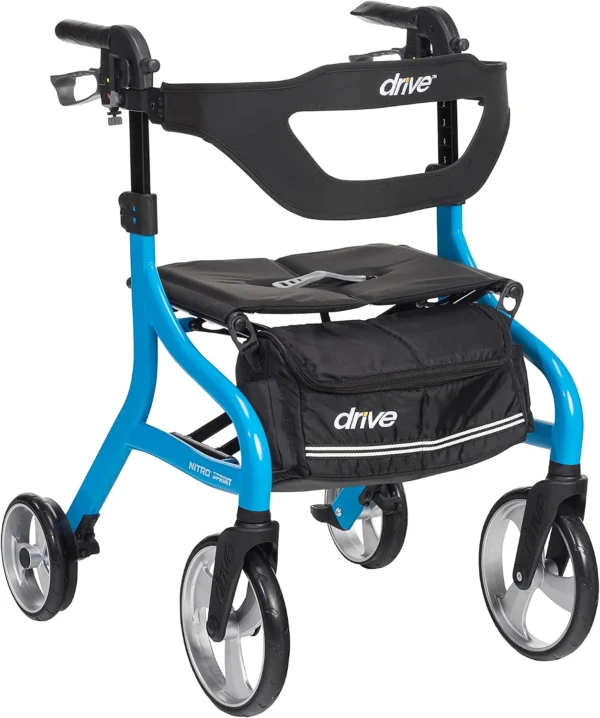
Drive Medical Nitro Sprint Rollator Walker
Features
- Weight: approximately 19 lbs
- Weight capacity: 350 lbs
- Frame: aluminum
- Front wheels: 10″
- Fold type: one-handed side fold
- Brakes: free, park and slowdown modes
- Seat: padded
- Backrest: contoured and adjustable
More features: large front casters; dual-sided curb assist; multiple storage-bag mounting positions; accessory port; hidden brake cables.
Of all the walkers available, we consider the Drive Medical Nitro Sprint earns our Editor’s Choice because it combines the stability and comfort expected from a premium four-wheel rollator with several thoughtful features that make it particularly well suited to everyday senior mobility.
At approximately 19 pounds, it is reasonably light for a full-featured rollator while still supporting users up to 350 pounds. The large 10-inch front casters roll smoothly across pavement, thresholds and other everyday surfaces, while the aluminum frame feels substantially more rigid than many inexpensive lightweight walkers. Drive also redesigned the Sprint with a one-handed folding system, making it easier to collapse for a car or storage.
The standout feature for us is the braking system. In addition to normal braking and a parking lock, the Nitro Sprint includes a slowdown mode, which applies extra rolling resistance when needed. That can be particularly useful on slopes where a freely rolling rollator can otherwise begin moving faster than the user would like.
Comfort is also strong. The padded seat is relatively generous, and the contoured backrest provides better support during rest stops than the thin strap-style backrests found on many basic rollators. Current Amazon feedback is also extensive, with more than 2,000 ratings on this exact model, giving the Sprint a substantial real-world ownership history.
What we liked
The Nitro Sprint feels like a walker that has been designed around the small frustrations people actually encounter. The one-handed fold was simple for us to use, the large front wheels make thresholds and pavement joints easier to negotiate, and the slowdown brake gave much more control on our test ramp than a conventional free-rolling rollator.
The frame also strikes a good balance between weight and solidity. It does not feel flimsy, yet at around 19 pounds it remains realistic when we tried to lift into our vehicle. Generally, we found we like its sturdy feel and smooth rolling, particularly around curbs and everyday outdoor surfaces.
What could be better
The storage arrangement is not perfect. One that we did find is that the bag can be awkward to access depending on where it is mounted, and sometimes we needed to walk around the walker rather than simply reaching down from the seated position.
The Sprint is also longer and more substantial than a petite or three-wheel rollator, so it is not the slim choice for very small apartments or narrow hallways.
2. Best Walker for Comfort

Amazon
Medline Premium Empower Rollator Walker
Features
- Weight: approximately 23 lbs
- Weight capacity: 300 lbs
- Wheel size: 8″
- Handle height: approximately 31.5″–39.5″
- Seat size: approximately 16″ x 14″
- Seat height: adjustable from approximately 20.5″
- Frame: aluminum
- Brakes: ergonomic locking loop brakes
More features: memory-foam seat; reversible padded backrest; flip-up seat; cup holder; under-seat storage; bright adjustment points.
The Medline Premium Empower is perfect for those looking for the deluxe model. If you expect to stop and sit regularly while using your walker, the Medline Premium Empower is one of the strongest comfort-focused rollators available.
The key difference is its seating. Rather than a thin vinyl pad, the Empower uses an extra-wide memory-foam seat measuring approximately 16 x 14 inches, paired with a padded backrest that can flip forward or backward. The seat itself also lifts, allowing the user to step further inside the frame when approaching a counter, chair or other surface.
The frame supports up to 300 pounds, uses 8-inch wheels and weighs around 23 pounds. Handle height can be adjusted from approximately 31.5 to 39.5 inches on the current Amazon configuration.
We particularly liked the brake handles. They are broad, easy to grasp and lock down for parking, which is useful for seniors with reduced hand strength.
What we liked
Comfort was clearly the Empower’s strongest point even greater so than the Drive Sprint. The memory-foam seat feels much more substantial than the typical hard or lightly padded rollator seat, and the reversible backrest gives you more flexibility when taking a break.
The flip-up seat is another excellent detail. Being able to move farther inside the frame makes the walker more practical when approaching a kitchen bench, bathroom counter or dining chair instead of having the seat constantly blocking the user’s path. Medline itself highlights this step-inside design as a defining feature.
The 8-inch wheels are also large enough for ordinary indoor and outdoor use without making the walker feel excessively bulky.
What could be better
The downside of all that comfort is size and weight. At around 23 pounds, we found that this is noticeably heavier than lightweight alternatives, and the broad frame may be inconvenient in older homes with narrow doorways.
Width seems to be one of the recurring concerns around larger Medline rollators, particularly with older or unusually narrow door openings.
If you rarely use the seat and need to lift your walker into a car several times per day, we’d probably sacrifice some comfort for a lighter model.
3. Best Upright Walker for Seniors
Amazon
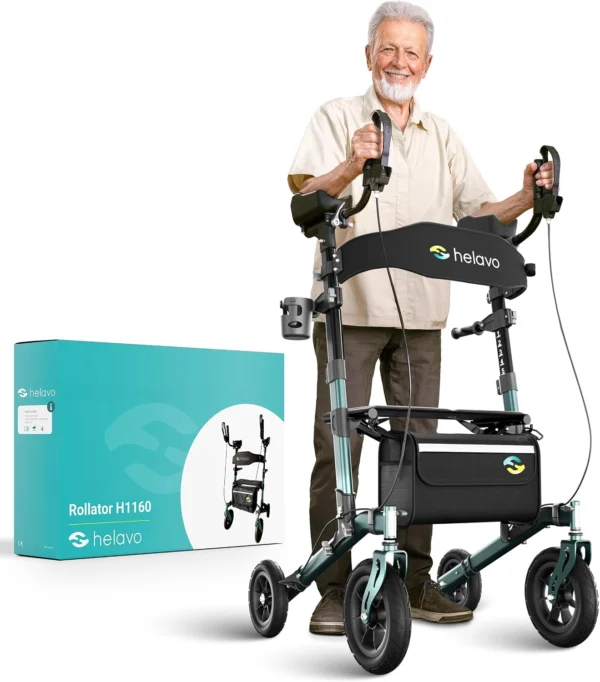
Helavo All-Terrain Upright Walker
Features
- Weight: approximately 22.7 lbs
- Weight capacity: 300 lbs
- Dimensions: approximately 26.4″ x 26.4″ x 46.9″
- Frame: aluminum
- Wheels: large flat-free rubber tires
- Folded size: approximately 14.6″ x 26.4″ x 40.9″
- Support type: padded forearm supports
- Seat: included
More features: height-adjustable forearm supports; ergonomic handles; all-terrain tires; tool-free assembly; storage; upright walking position.
For seniors who find themselves leaning forward over a conventional walker, the Helavo All-Terrain Upright Walker offers a very different walking position.
Instead of placing most of the support through the hands and wrists at hip level, padded forearm rests allow the user to stand more upright while transferring some weight through the forearms. This can be useful for people who find conventional rollators encourage excessive stooping or aggravate wrist and hand discomfort.
The current model weighs approximately 22.7 pounds, supports up to 300 pounds, and measures around 26.4 inches wide. Large puncture-resistant rubber tires provide more cushioning than small hard-plastic wheels, while the aluminum frame keeps the overall weight reasonable for an upright model. At 26.4 inches wide, it should pass through many standard doorways, but this is still a substantially larger walker than a petite or three-wheel model.
What we liked
We found that the forearm support is the main reason to choose this walker. The padded platforms make it easier to maintain a more upright torso without relying entirely on hand grip strength. We also like that Helavo paired the upright design with proper larger rubber tires. Many upright walkers are essentially indoor rollators with taller handles, whereas this model feels better suited to longer walks and mixed surfaces.
The adjustment range is also generous, which helps make an upright walker useful for a broader range of users. Helavo’s current listing carries a strong 4.5-star Amazon rating, and feedback around the brand frequently praises both the sturdiness of the products and customer support.
What could be better
The upright design comes at the cost of compactness. At roughly 26.4 inches wide and nearly 23 pounds, this is not something we’d choose for a small apartment with tight turns and narrow internal doorways. The forearm supports also make the upper section feel bulkier when transporting it than a conventional rollator.
It is also important to get the forearm height correct. An upright walker that is adjusted too high or too low can simply replace one poor posture with another.
4. Best Outdoor Walker
Amazon
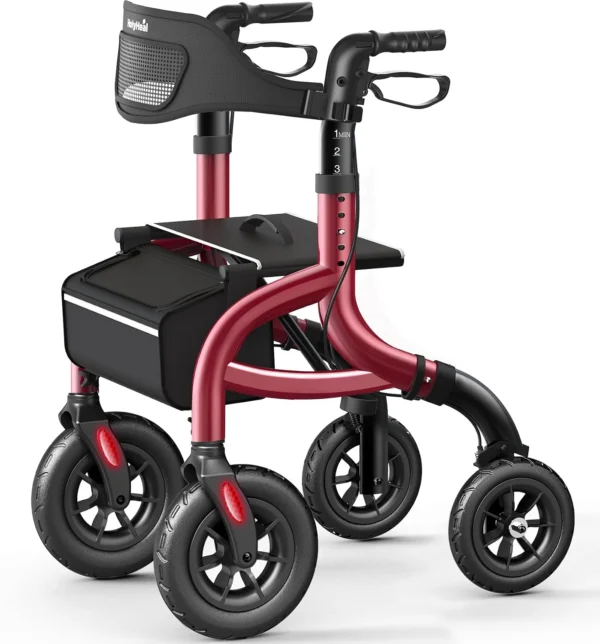
HolyHeal 10-Inch All-Terrain Rollator Walker
Features
- Weight: approximately 16.5 lbs
- Weight capacity: 350 lbs
- Wheel size: 10″
- Seat width: approximately 17.5″
- Frame: reinforced aluminum
- Backrest: breathable padded support
- Foldable: yes
- Brakes: locking hand brakes
More features: triangular reinforced frame; cane holder; cup holder; adjustable handles; seat and backrest; large all-terrain wheels.
The HolyHeal All-Terrain Rollator impressed us on paper because it manages to combine three characteristics that usually fight against one another: large wheels, a high weight capacity and relatively low overall weight. It weighs only about 16.5 pounds but supports up to 350 pounds. The frame uses a reinforced triangular structure, and the large 10-inch wheels are designed to provide better rolling performance over pavement joints, rough paths and uneven outdoor surfaces than the small 6-inch wheels found on basic indoor rollators. The seat is also reasonably generous at approximately 17.5 inches wide, with a breathable backrest for resting during longer outings.
That makes it an interesting middle ground between ultra-light rollators and heavy outdoor walkers.
What we liked
The biggest advantage is the weight-to-capacity ratio. A 16.5-pound walker that can support 350 pounds is much easier to load into a vehicle than the older 25–30-pound outdoor rollators that used to dominate this category.
The 10-inch wheels also make a noticeable difference conceptually for outdoor use. Larger wheels are less easily stopped by pavement joints, small stones and thresholds, while the seat gives you somewhere to rest during longer walks. A nice touch we found was the inclusion of a cane holder and cup holder, because those are precisely the accessories people tend to add later.
What could be better
While this is marketed as an “all terrain” model, we found that what it was really saying is that there is some grip/texture on the wheels and a beefy frame. While not a bad thing and will certainly go outdoors, it did make for a much more bulky feel to the walker, so had a pretty signficant trade off compared to some of the others like the Medline. Time will tell if this is a great outdoor model, or just as good as some of the others but from what we saw, are happy to give it a go.
5. Best Heavy Duty Walker for Seniors
Amazon
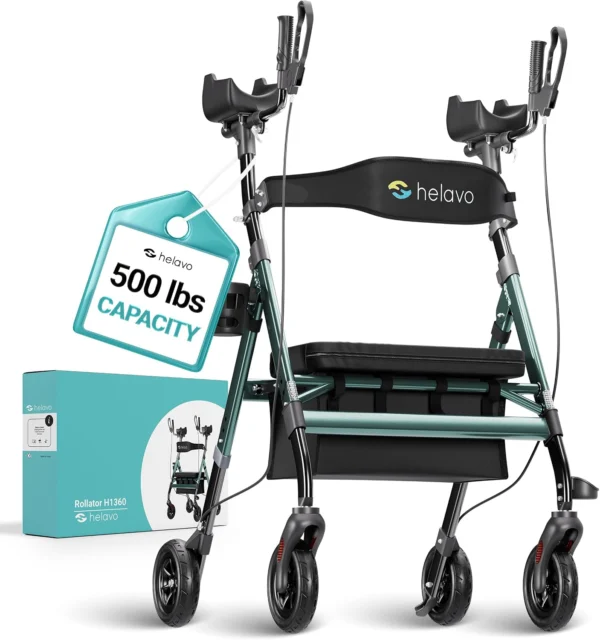
Helavo Extra-Wide Bariatric Upright Walker
Features
- Weight capacity: 500 lbs
- Seat width: approximately 20.1″
- Overall width: approximately 28.3″
- Wheel size: 8″
- Tires: flat-free solid rubber
- Frame: reinforced aluminum
- Support: padded upright forearm rests
- Seat and backrest: extra-wide
- Foldable: yes
More features: height-adjustable upright supports; all-terrain wheels; parking brakes; wide frame; ergonomic forearm pads.
The Helavo Extra-Wide Bariatric Upright Walker is the clear heavy-duty choice in this lineup because it is designed around a genuine 500-pound capacity, rather than simply adding a few pounds to a standard rollator rating. The seat is approximately 20.1 inches wide, giving larger users significantly more room than the narrow 12–17-inch seats common on standard rollators. The frame itself is around 28.3 inches wide and uses 8-inch flat-free rubber wheels.
It also uses an upright design with padded forearm supports, which can be useful for users who find it uncomfortable to place significant weight through their hands and wrists.
What we liked
The extra width immediately makes more sense for a bariatric user than trying to reinforce a normal-size walker. The seat actually provides useful room, the frame feels proportioned for higher loads, and the 500-pound capacity gives much more margin than the 250–350-pound ratings typical of ordinary rollators.
We also like the combination of bariatric capacity with upright forearm support. It means this isn’t simply a wider conventional walker; it addresses posture and pressure distribution as well. Helavo’s customer-service reputation is another positive and in our own dealings with them, they have been great for warrant support when needed.
What could be better
The width is both its strength and its biggest weakness. At around 28.3 inches, you need to measure doorways carefully. This is not a walker we’d order without first checking the narrowest doorway, bathroom entrance and hallway in the home. It is also bulkier to fold and transport than a standard rollator, even though the aluminum construction keeps weight lower than an equivalent steel bariatric frame.
Finally, larger users should pay particular attention to seat width rather than looking only at the 500-pound rating. Capacity alone does not guarantee comfortable fit and for some of our test subjects, this was certainly the case.
6. Best Walker for Petite Seniors
Amazon
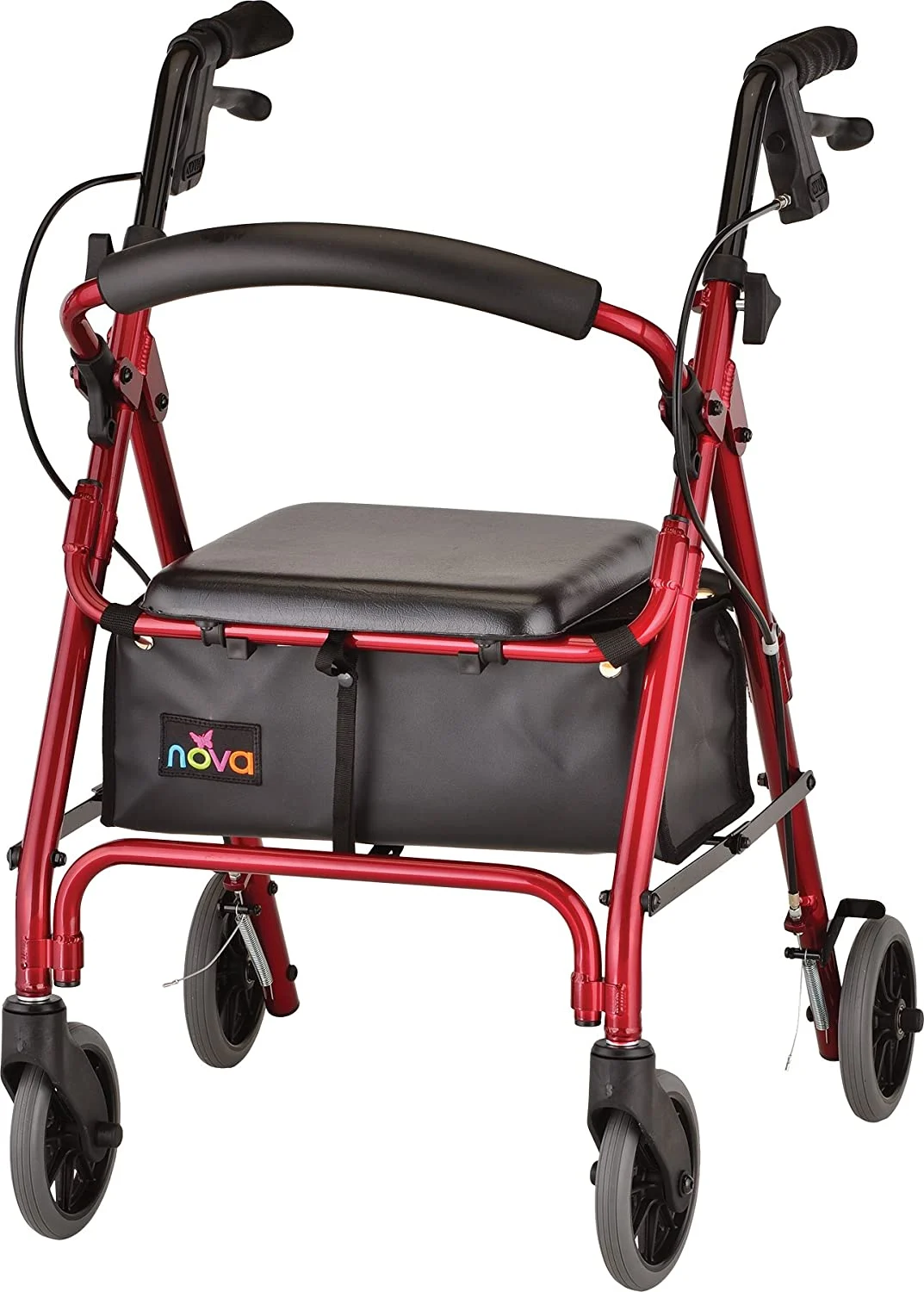
NOVA GetGo Petite Rollator Walker
Features
- Recommended user height: approximately 4’10″–5’4″
- Weight: approximately 13 lbs
- Weight capacity: 300 lbs
- Seat height: 18.5″
- Seat size: approximately 12″ x 12″
- Handle height: approximately 29″–33.25″
- Width between handles: 15.75″
- Overall width: 22″
- Wheels: 6″
More features: Lock n’ Load; 2” thick padded seat; lifetime limited warranty on walker; 5-year warranty on all brake parts; pouch with a pocket
We find the NOVA GetGo Petite Rollator Walker one of the best narrow walkers for smaller seniors. This model is designed for shorter users who are between 4’10” and 5’4” with a handle height range of 29” to 33.25”. Its width between the handles is just 15.75 inches, making it perfect for small spaces. Overall, the NOVA GetGo Petite is not only compact but also very lightweight – and it weighs only 13 lbs!
What makes the NOVA GetGo Petite Rollator Walker different from other items on our list is the patented feather touch hand brakes, making it easy for seniors to park or lock the brakes with a gentle push. Additionally, its brakes are a bit easier to use than the Drive Medical Nitro Sprint.
What we liked
The proportions are the biggest strength. Shorter users often end up with handles that are too high or a seat that leaves their feet dangling. The GetGo Petite fixes that by scaling the entire walker down rather than merely offering another notch in the handle adjustment.
The 13-pound weight is another advantage. It folds into a compact package, and NOVA’s Lock & Load mechanism helps hold the frame closed when lifting it into a vehicle. We found that for people under five feet, they finally feel properly fitted rather than adapting themselves to a standard-size walker.
What could be better
The small frame inevitably means a small seat. At approximately 12 x 12 inches, this is more of a short rest perch than a roomy chair. In our testing, we also noticed the 6-inch wheels also make it less suitable for rough outdoor paths than something like the HolyHeal. Brake adjustment is another area worth monitoring. There are occasional owner questions and complaints around brake performance, so we’d make sure both sides engage evenly before relying on it heavily.
7. Best Walker for Narrow Spaces
Amazon
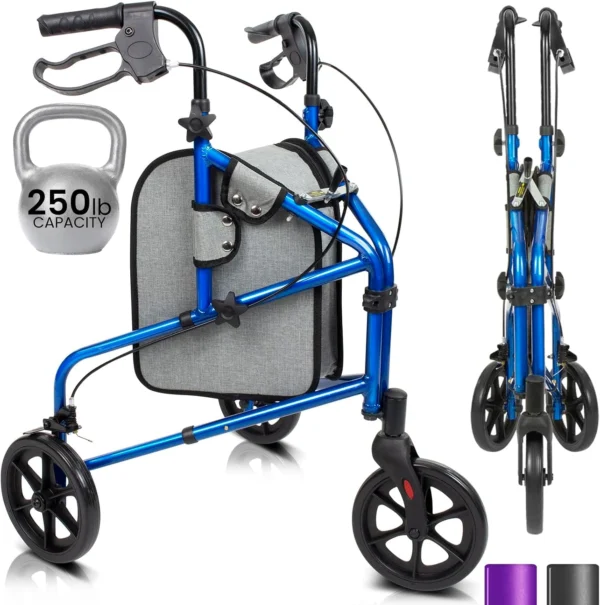
Vive Mobility 3-Wheel Rollator
Features
- Weight: approximately 11 lbs
- Weight capacity: 250 lbs
- Wheel size: 8″
- Handle height: approximately 31.5″–38″
- Folded width: approximately 9″
- Frame: aluminum
- Brakes: ergonomic locking hand brakes
- Seat: none
More features: three-wheel configuration; narrow turning circle; removable storage bag; adjustable handles; folds flat for vehicle transport.
The Vive 3-Wheel Rollator is the walker we’d choose when maneuverability matters more than having a seat. At just 11 pounds, it is exceptionally easy to lift and transport. More importantly, the three-wheel design gives it a much tighter turning circle than conventional four-wheel rollators. It can pivot through kitchens, narrow hallways, shop aisles and crowded spaces where a wide seated walker can become frustrating.
The frame collapses to around 9 inches wide, making it easy to store in a car or against a wall. Handle height adjusts from roughly 31.5 to 38 inches, and the large 8-inch wheels are considerably more capable over thresholds than the tiny casters found on some indoor walkers.
What we liked
The Vive is wonderfully nimble when we tested it out around our hallways and corridors. It changes direction with very little effort and can be partially narrowed when moving through especially tight spaces. That makes it feel far less cumbersome than a conventional rollator inside a small home.
At 11 pounds, we found that it is also one of the easiest walkers here to lift into a car. The storage bag is larger than expected and sits conveniently between the side frames.
What could be better
The trade-off is stability and this was certainly noticeable with some of our older people. A three-wheel rollator has a smaller support footprint than a four-wheel model, so it is not our preferred choice for someone with significant balance impairment or someone who needs to place substantial body weight through the walker.
There is also the obvious issue of no seat, which immediately rules it out for users who need frequent seated rest breaks. This is therefore best viewed as a lightweight maneuverability aid, not a substitute for a highly stable four-wheel or standard walker where maximum support is needed.
Why Many Seniors Benefit from Using a Walker
A correctly selected walker can make everyday activities such as walking around the home, shopping or going for a walk more manageable.
There are several reasons a walker may be useful for seniors.
Improve Balance & Stability
Walkers provide additional points of contact with the ground and can provide useful support for people who feel unsteady while walking.
However, a walker needs to be the correct type, correctly adjusted and used appropriately. Mobility aids do not automatically prevent falls, and inappropriate sizing or use can create additional hazards.
Reduce Joint & Muscle Strain
A correctly selected walker can allow some load to be transferred through the arms and assist people who experience discomfort, weakness or reduced endurance in the lower body.
Different walker types distribute this load differently. For example, Helavo All-Terrain Upright Walker uses forearm supports, while a conventional rollator such as the Drive Medical Nitro Sprint Rollator Walker transfers support through the hands.
Support Independence
Many seniors feel more confident leaving the house, shopping or walking outdoors when they have an appropriate mobility aid available.
A walker with a seat can also provide somewhere to rest before fatigue becomes excessive.
Stay Active Longer
Regular walking can remain an important part of staying active with age, and the right mobility aid can make continued walking more practical for someone whose balance, strength or endurance has declined.
The goal should be to choose a walker that supports safe movement rather than one that encourages the user to exceed their physical abilities.
How to Choose the Best Walker for Seniors
If you have already found a reason to buy a walker, there are several things to consider before making a purchase. They include the type of walker, dimensions, fit, wheels, foldability, weight capacity and intended environment.
Let’s take a closer look at each.
Expert Insight
Walkers are often incorrectly sized, which can make them harder rather than easier to use. For conventional walkers and rollators, handle height is commonly adjusted around wrist-crease level when standing upright with the arms relaxed, although individual requirements can vary. Upright walkers require different adjustment because support is provided through the forearms. If there is any uncertainty, a physical or occupational therapist can help confirm the appropriate walker type and fit.
Reviewed by Ray Butcher, Certified Senior Fitness Instructor
Walker Type
There are several major walker designs, and they provide different levels of support and maneuverability.
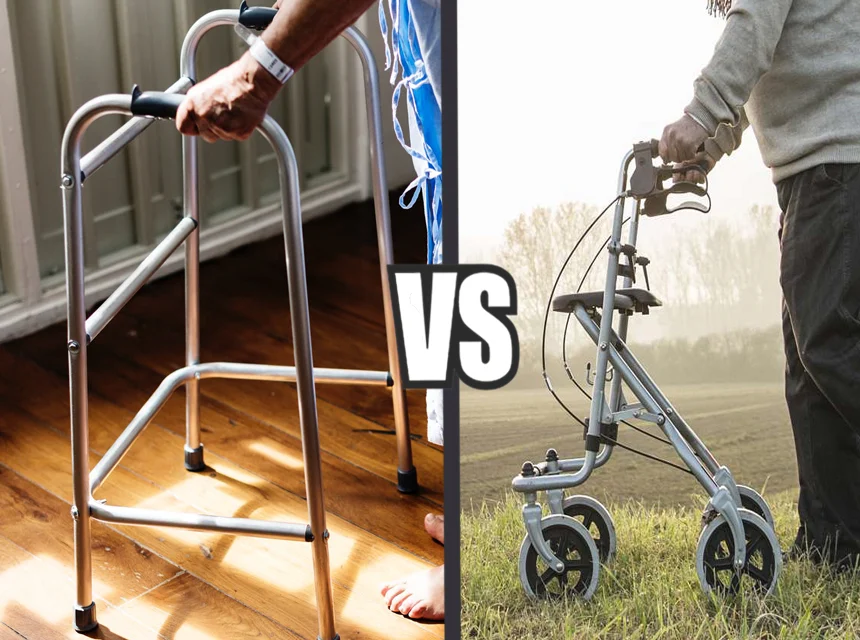
- Standard walkers: Provide a large, stable support frame but must generally be lifted and advanced with each step.
- Front-wheeled walkers: Easier to move forward because the front wheels can roll while the rear legs maintain more resistance.
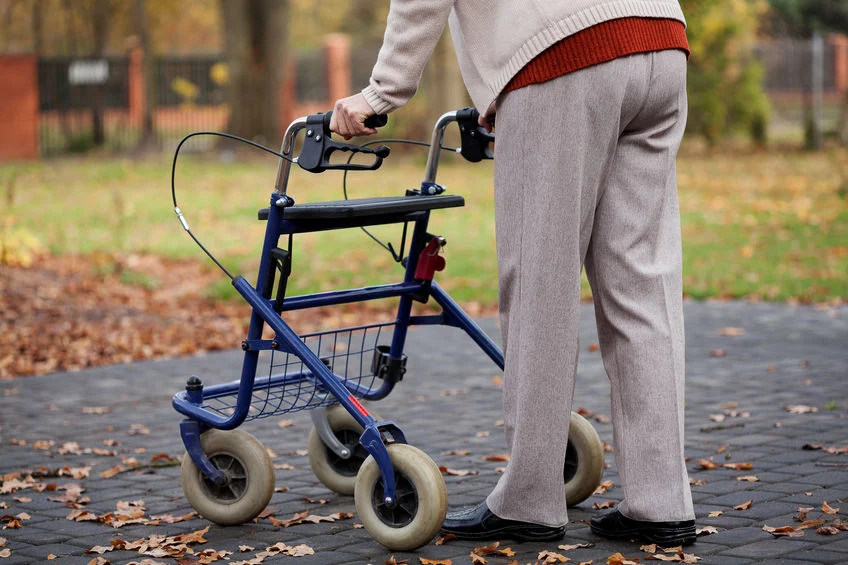
- 4-wheel rollators: Highly mobile and commonly include brakes, storage and a seat, but the user needs sufficient control to manage a freely rolling device.
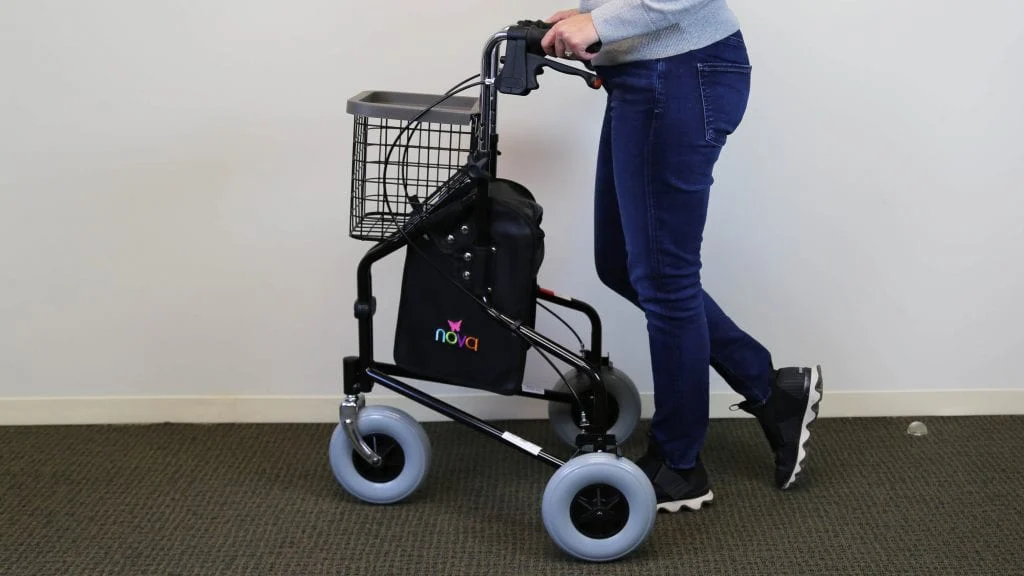
- 3-wheel rollators: Narrower and extremely maneuverable, but with a smaller support footprint and usually no seat.
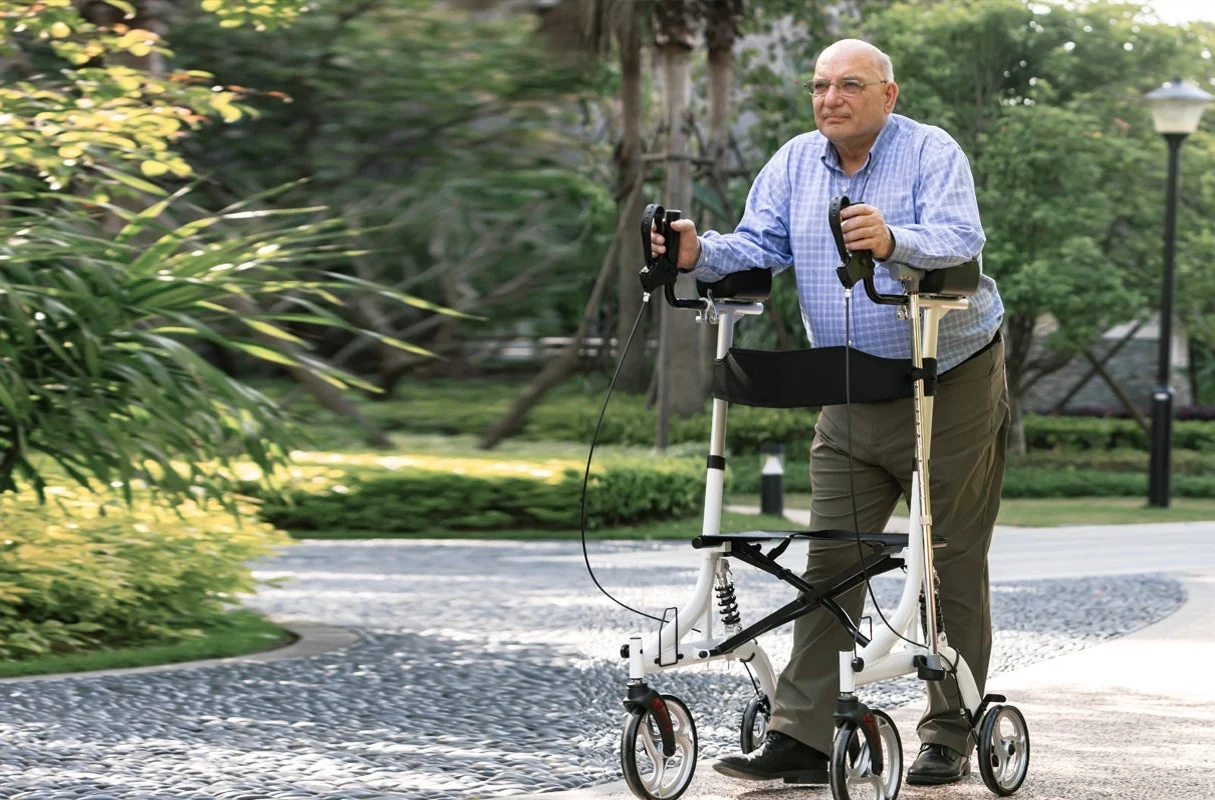
- Upright walkers: Use higher forearm supports to encourage a more upright position and reduce reliance on the hands and wrists.
The correct type matters more than the number of features.
Someone who needs substantial weight-bearing support should not automatically choose a four-wheel rollator simply because it is easier to push.
Adjustability & Fit
Correct fit is one of the most important considerations.
For a conventional walker or rollator, the handles should generally allow the user to stand naturally with a slight bend at the elbow rather than forcing the shoulders upward or encouraging excessive stooping.
Shorter users may struggle to achieve this on a full-size walker. That is why a purpose-built model such as the NOVA GetGo Petite Rollator Walker can be preferable to simply lowering the handles of a large rollator.
Upright walkers need particular care because the forearm supports and handles both need to suit the user.
Weight Capacity
Always check the manufacturer’s capacity before purchasing.
Most general-purpose walkers and rollators in this guide support approximately 250–350 pounds, but this varies substantially.
For users requiring significantly greater capacity, the Helavo Extra-Wide Bariatric Upright Walker supports up to 500 pounds.
Do not consider capacity in isolation, however. Seat width, space between the handles and overall frame dimensions also determine whether a walker will fit comfortably.
Frame Width & Dimensions
Measure the environment where the walker will actually be used.
Important measurements include:
- narrow doorways
- bathroom entrances
- corridors
- gaps between furniture
- kitchen spaces
- car-trunk openings
The NOVA GetGo Petite Rollator Walker is particularly well suited to smaller users and narrower environments.
For maximum maneuverability, the Vive Mobility 3-Wheel Rollator has a narrow three-wheel design that can pivot through spaces where a larger four-wheel rollator may feel cumbersome.
At the other extreme, the Helavo Extra-Wide Bariatric Upright Walker is around 28 inches wide, so checking doorways before purchase is essential.
Wheels & Tires
Wheel size has a significant effect on how easily a walker passes over small obstacles and surface changes.
Smaller wheels can keep a walker compact and maneuverable indoors.
Larger wheels tend to roll more easily across pavement joints, cracks, thresholds and uneven outdoor surfaces.
Our HolyHeal 10-Inch All-Terrain Rollator Walker uses 10-inch wheels and is the strongest outdoor-focused choice in this lineup.
The Drive Medical Nitro Sprint Rollator Walker also uses large 10-inch front wheels, making it a strong general-purpose indoor/outdoor option. Drive additionally equips the Sprint with an integrated slowdown brake to help manage rolling speed on varied terrain.
Three Wheels vs Four Wheels
A three-wheel walker such as the Vive Mobility 3-Wheel Rollator has several advantages:
- low weight
- excellent maneuverability
- narrow folded and operating width
- easy transport
However, the triangular wheel arrangement provides a smaller support footprint than a four-wheel rollator.
For someone with significant balance problems, a three-wheel model may therefore be less appropriate than a four-wheel or standard walker.
Four-wheel rollators generally feel more planted and commonly provide a seat, but they are wider and heavier.
Upright Walkers
Upright walkers such as the Helavo All-Terrain Upright Walker position the handles and supports higher than a conventional rollator.
The user places their forearms on padded supports rather than relying entirely on hand grip strength.
This can make an upright model worth considering for someone who:
- tends to stoop over a conventional walker
- experiences uncomfortable pressure through the hands or wrists
- prefers forearm support
- can safely control a rollator-style walker
However, the correct adjustment is important. Setting the supports too high or too low can create a poor walking position rather than correcting one.
Foldability & Carry Weight
If you regularly transport the walker in a vehicle, its weight may matter almost as much as how well it rolls.
The Vive Mobility 3-Wheel Rollator weighs approximately 11 pounds, while the NOVA GetGo Petite Rollator Walker is around 13 pounds.
The Drive Medical Nitro Sprint Rollator Walker weighs approximately 19 pounds for the standard model according to Drive, which is still reasonably manageable for a full-sized seated rollator.
The more features you add—large wheels, wide seats, upright supports and reinforced frames—the more likely overall weight is to increase.
Frame Materials
Most contemporary rollators in this guide use aluminum because it provides useful strength without the weight associated with an equivalent steel structure.
Steel remains common in walkers designed around maximum rigidity or particularly high loads.
However, material alone does not determine quality. Joint design, fasteners, wheel mounts, folding hinges and brakes are equally important.
Seat & Rest Options
A seat can be extremely useful for people who fatigue while walking.
If you expect to sit frequently, look beyond whether a seat merely exists.
Consider:
- seat width
- seat depth
- padding
- seat height
- back support
The Medline Premium Empower Rollator Walker is our comfort pick because its extra-wide memory-foam seat and reversible padded backrest are considerably more substantial than the basic seats fitted to many rollators. Medline also allows the seat to flip upward so the user can step farther inside the frame when needed.
The Vive Mobility 3-Wheel Rollator, by comparison, has no seat at all. That helps keep it light and narrow but makes it unsuitable for someone who needs regular seated breaks.
Brakes
Rollator brakes need to serve two different purposes.
The hand brakes control the walker while moving, while the parking brake should be engaged before sitting on a rollator seat.
Look for controls that are easy for the intended user to grip and lock.
The Drive Medical Nitro Sprint Rollator Walker adds a third function through its integrated slowdown brake, which creates additional resistance to help control rolling speed.
If hand strength or dexterity is limited, brake operation should be tested before relying on the walker independently.
Accessories
Common useful accessories include:
- storage bags
- cup holders
- cane holders
- trays
- phone holders
Do not allow accessories to interfere with safe operation or overload the walker.
The Medline Premium Empower Rollator Walker includes a cup holder and under-seat storage, while the HolyHeal 10-Inch All-Terrain Rollator Walker includes both a cane holder and cup holder.
Warranty & Price
Walker prices vary significantly depending on design and features.
A simple frame walker may cost relatively little, while premium rollators and upright walkers can cost several hundred dollars.
Higher prices may reflect:
- better wheels
- more sophisticated braking
- higher capacities
- better seating
- lighter materials
- stronger warranties
- more complex upright designs
For example, Drive currently provides a limited lifetime warranty on the Nitro Sprint frame and five years on the brake handle and housing.
Rather than choosing according to price alone, focus on the features that solve the user’s actual mobility problem.
How to Use a Walker Properly
A walker needs to be correctly adjusted and used according to its design.
For conventional walkers and rollators:
- Stand inside the support area rather than walking far behind the frame.
- Keep the walker close enough that you do not need to lean excessively forward to reach it.
- Use the hand grips or forearm supports as designed.
- Slow down before turning.
- With a rollator, use the hand brakes to control speed.
- Engage the parking brakes before sitting on a rollator seat.
- Avoid placing excessive weight on storage bags or hanging heavy objects from handles, as this may affect stability.
What About Stairs?
Do not assume that a normal walker or rollator can simply be used to walk up or down stairs.
The safe method depends on the user’s mobility, the type of device, the stairs and whether a railing or other support is available.
If stairs need to be negotiated regularly, ask a physical or occupational therapist to demonstrate the appropriate technique and determine whether another mobility aid or environmental modification would be safer.
Walkers for Seniors FAQ
What are the benefits of using a walker?
A correctly selected walker can provide additional support while walking, make it easier to remain active and give some users greater confidence when moving around the home or community.
The benefit depends on choosing the correct walker type and ensuring it is properly adjusted.
Which type of walker is safest for seniors?
There is no single walker type that is safest for every senior.
Someone who needs substantial weight-bearing support may require a standard or front-wheeled walker, while a person with better balance who mainly needs endurance assistance may find a four-wheel rollator easier to use.
Three-wheel and upright models solve other mobility problems but are not appropriate for everyone.
If balance impairment is significant, seek advice from a physical or occupational therapist before choosing.
What if I struggle using my walker?
First check whether the walker is correctly adjusted.
If you continue to struggle with balance, posture, brakes or coordination, ask a doctor, physical therapist or occupational therapist to assess both the walker and the way you are using it.
A different walker type may be more appropriate.
Can walkers be taken on airplanes?
Folding walkers and rollators can generally be transported as mobility aids, but procedures differ between airlines.
Contact your airline before travelling if you need to know how the walker will be handled, stored or returned to you at the aircraft door.
Are walkers with wheels better than standard walkers?
Not necessarily.
Wheeled walkers and rollators are easier to advance because they do not need to be lifted with each step. However, they can also roll away from the user and require adequate control.
A standard or front-wheeled walker may provide more appropriate support for some users.
What is the best walker for a short senior?
The NOVA GetGo Petite Rollator Walker is our preferred option for petite users because it is designed around people approximately 4’10″–5’4″, rather than simply being a standard rollator with lowered handles.
Its lower seat and compact dimensions also make it more comfortable for shorter users.
What is the best walker for narrow spaces?
The Vive Mobility 3-Wheel Rollator is our preferred choice where maneuverability and narrow spaces are the primary concerns.
Its three-wheel frame can negotiate tighter turns than most four-wheel rollators and folds to a very narrow profile.
However, we would not recommend a three-wheel walker merely for convenience if the user needs the greater support footprint of a four-wheel or standard walker.
What is the best walker for heavier seniors?
The Helavo Extra-Wide Bariatric Upright Walker is the highest-capacity model in our current selection, supporting up to 500 pounds.
Its seat and frame are also substantially wider than those of ordinary rollators.
Always check both weight capacity and physical dimensions to make sure the user fits the walker comfortably.
What is the best walker for outdoor use?
The HolyHeal 10-Inch All-Terrain Rollator Walker is our preferred outdoor model because its large 10-inch wheels are better suited to pavement joints and uneven paths than the smaller wheels fitted to many compact rollators.
For general-purpose indoor and outdoor use, the Drive Medical Nitro Sprint Rollator Walker is also a strong option because of its large front casters and slowdown brake.
Our Verdict
Overall, we believe the Drive Medical Nitro Sprint Rollator Walker offers the best balance of comfort, stability, portability and everyday usability for many seniors who are suited to a four-wheel rollator.
It supports up to 350 pounds, weighs approximately 19 pounds, uses large front casters and includes an integrated slowdown brake that gives it an advantage over many conventional rollators when controlling speed. Drive also uses a one-handed folding design that makes the Sprint easier to store or transport.
For seniors who place greater emphasis on resting comfort, the Medline Premium Empower Rollator Walker is our preferred alternative. Its extra-wide memory-foam seat, reversible padded backrest and flip-up seat provide considerably more comfort and flexibility than the simple seats fitted to many rollators.
The Helavo All-Terrain Upright Walker is the better choice for someone specifically seeking forearm support and a more upright walking position, while the HolyHeal 10-Inch All-Terrain Rollator Walker is our preferred option for regular outdoor walking.
For more specialised requirements, the Helavo Extra-Wide Bariatric Upright Walker provides a 500-pound capacity, the NOVA GetGo Petite Rollator Walker is proportioned specifically for shorter seniors, and the Vive Mobility 3-Wheel Rollator provides excellent maneuverability in confined spaces.
The most important point is that the best walker is the one that fits the person using it. Balance, height, strength, hand control, intended terrain and the amount of physical support required should all come before appearance or the number of accessories.
References
- Walkers with Wheels Versus Walkers Without Wheels for Fall Prevention in Older Adults: A Review of the Comparative Clinical Effectiveness – NCBI Bookshelf
One systematic review was identified regarding the comparative effectiveness of walkers with wheels versus walkers without wheels for fall prevention in older adults.
www.ncbi.nlm.nih.gov - Mobility Assistive Device Use in Older Adults – PubMed
Many individuals need a mobility assistive device as they age. These devices include canes, crutches, walkers, and wheelchairs.
pubmed.ncbi.nlm.nih.gov - Friend or foe? Study examines seniors’ increasing use of walking aids – ScienceDaily
America’s population of senior citizens is growing, and with it, a reliance on canes, wheelchairs and scooters. This proliferation of senior mobility devices is surprising considering that prior research showed a correlation between device use and falling — the leading cause of death resulting from injury among adults 65 and older.
www.sciencedaily.com - Walkers for Older Adults: How to Choose the Best One
Learn how to choose a walker for older adults by considering different styles, features, and more.
www.webmd.com