
Finding the right wheelchair shouldn’t feel overwhelming, but weight can make a huge difference to how practical a chair is in everyday life. Traditional manual wheelchairs can be cumbersome to lift into a vehicle, maneuver through tight spaces or handle repeatedly throughout the day, particularly when a caregiver is doing much of the lifting.
That is where a lightweight wheelchair can make life considerably easier. Modern designs use materials such as aluminum and magnesium to reduce weight while still offering the seating, brakes, footrests and durability needed for everyday mobility. Lightweight models are just one category within the broader range of wheelchair options for seniors, each suited to different mobility and lifting needs.
In this guide, we compare eight lightweight wheelchairs for seniors, including self-propelled manual wheelchairs, compact transport chairs and a folding electric option. The important point is that “lightweight” does not mean the same thing in every category: a 20-pound self-propelled chair is exceptionally light, while a 38-pound powered wheelchair can also be considered lightweight compared with conventional electric models.
Whether you want greater independence, need something easy to take to appointments or simply want a chair that is easier for a caregiver to lift into a car, the goal is to find the right balance between weight, comfort, portability and function.
SeniorFitness is reader-supported. We may earn a commission through products purchased using links on this page. Learn more about our process here
TL;DR
Our overall pick is the Karman Ergo Flight Ultra Lightweight Wheelchair. At around 19.8 pounds without the footrests on its smaller configurations, it achieves an impressive balance between low lifting weight and the large rear wheels required for self-propulsion.
If the chair will mainly be pushed by a caregiver, a transport wheelchair can be lighter still. The Medline Ultralight Transport Wheelchair is one of the lightest options in this guide, while the Drive Medical Fly Lite Ultra is another strong choice for frequent travel and vehicle transport.
The Hi-Fortune Lightweight Medical Manual Wheelchair provides an attractive middle ground for value-conscious buyers who still want self-propulsion, while the heavier Medline, ProBasics and Drive Cruiser III models trade some portability for greater adjustability, capacity and everyday wheelchair features.
For someone who needs powered mobility, the Traingiver Lightweight Foldable Electric Wheelchair is the outlier in this group. It is heavier than the manual chairs, but at around 38 pounds it remains unusually portable for a folding electric wheelchair.
Quick Summary
- Editor’s Choice – Best Ultra Lightweight Manual Wheelchair:Karman Ergo Flight Ultra Lightweight Wheelchair — A genuinely lightweight self-propelled chair with an aircraft-grade aluminum frame, removable rear wheels and footrests, and ergonomic seating. A strong choice where both independence and low lifting weight matter.
- Best Ultra Lightweight Transport Wheelchair:Medline Ultralight Transport Wheelchair — An exceptionally light caregiver-pushed chair with a folding frame and simple travel-friendly design. Best where minimizing lifting weight matters more than self-propulsion.
- Best Value Lightweight Manual Wheelchair:Hi-Fortune Lightweight Medical Manual Wheelchair — A magnesium-alloy manual chair weighing around 21 pounds with large rear wheels, brakes and anti-tippers. A useful lower-cost alternative to premium ultralight self-propelled chairs.
- Best Foldable Everyday Wheelchair:Medline MDS806550E Lightweight Wheelchair — Heavier than the ultralight models but more substantial for regular use, with a 300-pound capacity, elevating leg rests and adjustable features.
- Best Lightweight Travel Transport Chair:Drive Medical Fly Lite Ultra Lightweight Transport Wheelchair — A compact folding transport chair that keeps weight low while providing a 300-pound capacity and adjustable swing-away footrests.
- Best Adjustable Seating & Transfers:ProBasics Ultra Lightweight Wheelchair — A feature-rich manual wheelchair with adjustable seating components, folding frame and limited lifetime frame warranty.
- Best with Removable Flip-Back Arms:Drive Medical Cruiser III Lightweight Wheelchair — A configurable everyday manual chair with flip-back arms, adjustable seat depth and higher-capacity configurations.
- Best Lightweight Electric Wheelchair:Traingiver Lightweight Foldable Electric Wheelchair — A folding powered chair weighing around 38 pounds, aimed at users who want electric mobility without the bulk of a conventional power wheelchair.
Detailed Reviews: Best Lightweight Wheelchairs
1. Editor’s Choice: Best Ultra Lightweight Wheelchair for Seniors
Amazon
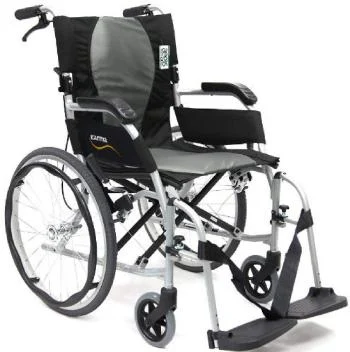
Karman Ergo Flight Ultra Lightweight Wheelchair
Features
- Type: manual self-propelled wheelchair
- Seat width: 16″, 18″ or 20″, depending on configuration
- Wheelchair weight: approximately 19.8 lbs without footrests on 16″ and 18″ models
- Weight limit: 220 lbs on 16″ and 18″ models; 250 lbs on 20″ model
- Frame: 6061 T-6 aircraft-grade aluminum
- Folded width: approximately 13″
Other features: ergonomic S-style seat frame; AEGIS padded upholstery; fixed desk-length armrests; removable swing-away footrests; companion brakes; folding backrest and seat; storage pocket.
The Karman Ergo Flight remains our Editor’s Choice because it achieves something relatively few manual wheelchairs manage: it is genuinely light enough to make a noticeable difference when loading it into a car, while still retaining the large rear wheels needed for self-propulsion. Karman lists the 16- and 18-inch versions at about 19.8 pounds without the footrests, with the frame itself dropping to around 14.5 pounds when the quick-release rear wheels and footrests are removed.
The frame uses 6061 T-6 aircraft-grade aluminum, but what makes the chair more distinctive is Karman’s patented ergonomic seat geometry. Instead of a completely flat sling-style seating position, the S-shaped frame is intended to provide a more natural seated posture. The chair also folds through both the seat and backrest, and the removable footrests help reduce its transport bulk even further.
What do we love it for?
The biggest advantage is the weight-to-function ratio. Plenty of transport chairs weigh less, but they normally require someone else to push them. The Ergo Flight gives you a genuinely lightweight chair with full-size rear wheels, so it retains much more independence for a user who has sufficient upper-body strength to self-propel.
We also like how much of the weight can be removed before lifting. Taking off the footrests and quick-release rear wheels makes the frame substantially easier to load into a vehicle, which can matter as much to a caregiver as the total assembled weight.
What could be better?
The main limitation is its relatively modest 220-pound capacity on the 16- and 18-inch versions. Larger users may need the 20-inch configuration, which raises capacity to 250 pounds but also increases the chair weight.
The fixed armrests also offer less transfer flexibility than flip-back arms, and the chair is better suited to relatively smooth everyday surfaces than rough outdoor terrain. If your main priority is caregiver-assisted travel rather than self-propulsion, a dedicated transport chair may be simpler and cheaper.
2. Best Transport Wheelchair
Amazon
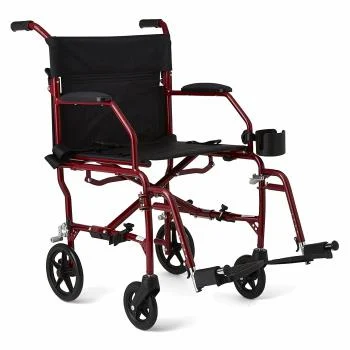
Medline Ultralight Transport Wheelchair
Features
- Type: attendant-propelled transport wheelchair
- Seat size: approximately 19″ W x 16″ D
- Wheelchair weight: approximately 14.8 lbs
- Weight limit: 300 lbs
- Rear wheels: 12″
- Frame: aluminum
- Folded width: approximately 12″
- Warranty: 1-year limited
Other features: attendant handbrakes; locking brake function; padded full-length armrests; swing-away detachable footrests; seat belt; nylon upholstery.
The Medline Lightweight Transport Wheelchair is our pick for caregivers who want better speed control than a basic transport chair provides. Unlike a self-propelled wheelchair, this model is designed to be pushed by an attendant, and the brake levers are positioned directly at the push handles. This makes it much easier for the person behind the chair to slow or secure it without reaching down toward the wheels.
The configuration we tested weighs about 25 pounds, supports up to 300 pounds, and uses 12-inch rear wheels with smaller front casters. The larger rear wheels help it deal with minor pavement changes and everyday outdoor surfaces better than very small-wheel transport chairs, while the swing-away footrests make transfers simpler.
What do we love it for?
The handbrakes are the main reason to choose this Medline. They give the caregiver useful control on slopes and allow the chair to be secured before the user gets in or out, which is a meaningful improvement over transport chairs that rely only on wheel-mounted locks.
We also like the 12-inch rear wheels. They make this chair feel less nervous over small surface changes than compact transport chairs with equally small wheels at both ends.
What could be better?
At around 25 pounds, this is no longer an ultralight chair. It is still much easier to load than a traditional 40- to 50-pound wheelchair, but anyone prioritizing minimum lifting weight should look at the Drive Fly-Lite instead.
This is also an attendant chair, not a self-propelled wheelchair. The smaller rear wheels mean the seated user cannot independently wheel themselves around in the same way they can in the Karman or Hi-Fortune.
3. Best Value Lightweight Wheelchair
Amazon
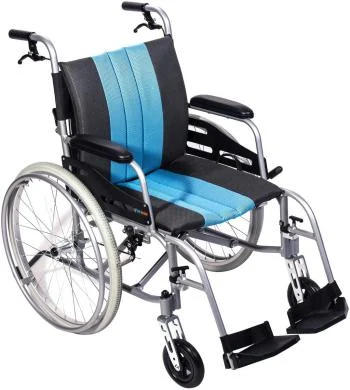
Hi-Fortune Lightweight Medical Manual Wheelchair
Features
- Type: manual self-propelled wheelchair
- Seat width: approximately 17.5″
- Wheelchair weight: approximately 21 lbs
- Weight limit: 220 lbs
- Rear wheels: 22″ quick-release
- Frame: magnesium alloy
- Footrests: swing-away and removable
Other features: hand and rear brakes; anti-tippers; padded armrests; quick-release rear wheels; folding frame; travel-friendly design.
The Hi-Fortune Lightweight Manual Wheelchair remains one of the better-value choices for someone who wants a genuinely light self-propelled chair without moving into premium Karman pricing. Its magnesium-alloy frame helps hold the chair to around 21 pounds, while the 22-inch rear wheels still allow the seated user to propel themselves rather than relying entirely on a caregiver.
The chair also includes features that make transport easier, including quick-release rear wheels, swing-away removable footrests and a folding frame. Hi-Fortune includes both hand and rear brakes plus anti-tippers, giving the chair more safety hardware than many inexpensive lightweight models.
What do we love it for?
The strongest feature is how much manual-wheelchair functionality you get at only 21 pounds. The quick-release rear wheels make it possible to break the chair down further for lifting, while the magnesium frame keeps the main structure relatively light.
We also like that this is not simply a travel transport chair. The large rear wheels give the user the option of self-propulsion, which makes it more useful for someone who still has adequate upper-body strength and wants to maintain some independence.
What could be better?
The 220-pound capacity is fairly restrictive compared with the 300-pound ratings common on many standard wheelchairs. The chair is also approximately 27–28 inches wide across the wheels, so checking narrow doorways before purchase is important.
Its lightweight construction also means it should not automatically be treated as a heavy-duty outdoor chair. It works best where portability matters more than maximum ruggedness.
4. Best Foldable Lightweight Wheelchairs for Seniors
Amazon
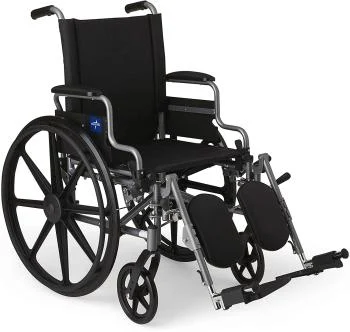
Medline MDS806550E Lightweight & User-Friendly Wheelchair
Features
- Weight capacity: 300 lbs
- Weight: 33 lbs
- Dimensions: 31.5 x 25.5 x 36.5 in
- Warranty: lifetime limited on frame, 1-year limited on components
More features: removable arms, elevating leg rests, nylon upholstery, 16×18 in set width
The Medline Lightweight wheelchair has a simplistic design that not only enhances its usability but aids transport. The chair features mag wheels that are made from cast iron and magnesium to improve heat conduction and reduce brake failure risk. These wheels are also longer lasting and easier to steer. While the main frame is made of steel for stability.
This is a great option for new users. Wheelchairs can be a little daunting for new users, particularly when they have a complicated design. However, the Medline Lightweight is straightforward and easy to use. You can easily adjust the seat height and removing the leg rests is simple. You also don’t have to worry about tire punctures or leaks, as the model features flat free tires.
What makes it special?
- What we liked about this chair is how comfortable and easy it is to maneuver. While the frame and wheels are sturdy and durable, yet the chair is quick to assemble and requires very little maintenance. Despite this, the chair can hold up to 300 pounds, which makes it suitable for most users, particularly if you have concerns about how to use the chair and transport it.
What cons did we find?
- One area that needs work is the leg rest design. While it swings back it is not at a complete 180 degree angle. This means that they can get in the way when you’re trying to fit the chair through a door. Also, the brake is quite close to the frame of the chair, so it is possible to trap your fingers if you’re not careful.
5. Best Lightweight Wheelchair with Adjustable Footrests
Amazon
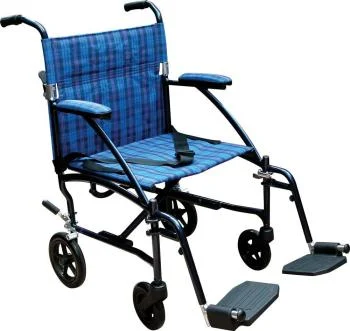
Drive Medical Fly Lite Ultra Lightweight Transport Wheelchair
Features
- Type: manual transport wheelchair
- Seat size: 15.25” x 18.75”
- Wheelchair weight: 19 lbs
- Weight limit: 300 lbs
- Dimensions: 33” x 22” x 36”
- Warranty: limited lifetime
Other features: aluminum rear wheel locks; 33″ x 9″ x 36″ folded dimensions
The Drive Medical Fly Lite Ultra Lightweight Transport Wheelchair only weighs 19 pounds and is one of the lightest wheelchairs on the market. It features an attractive blue plaid nylon upholstery that is easy to clean and durable at the same time. This chair features a carry pocket on the back rest so you have enough room to store all your personal belongings.
The seatbelt makes this chair very safe to use, and you don’t have to use any kinds of tools to assemble it. The foot rests can be adjusted in height and you can also swing them out of the way if needed. The back release makes it super easy to fold down the back, which means the chair is very easy to transport and store. The aluminum frame of the Drive Medical Fly Lite Ultra Lightweight Transport Wheelchair is strong yet lightweights, and the black paint job makes it suitable for most users.
When it comes to the braking system, the Drive Medical Fly Lite Ultra Lightweight Transport Wheelchair has responsive aluminum brakes and its safety is enhanced by the standard rear wheel locks.
Why is it special? The Drive Medical Fly Lite Ultra Lightweight Transport Wheelchair is extra light and folds down easily for storage and transport.
What are the flaws? Some of the users who tested this chair mentioned that it is a bit difficult to pass over higher doorway transitions in this chair.
6. Best Adjustable Seating & Transfers: ProBasics Ultra Lightweight Wheelchair
Amazon
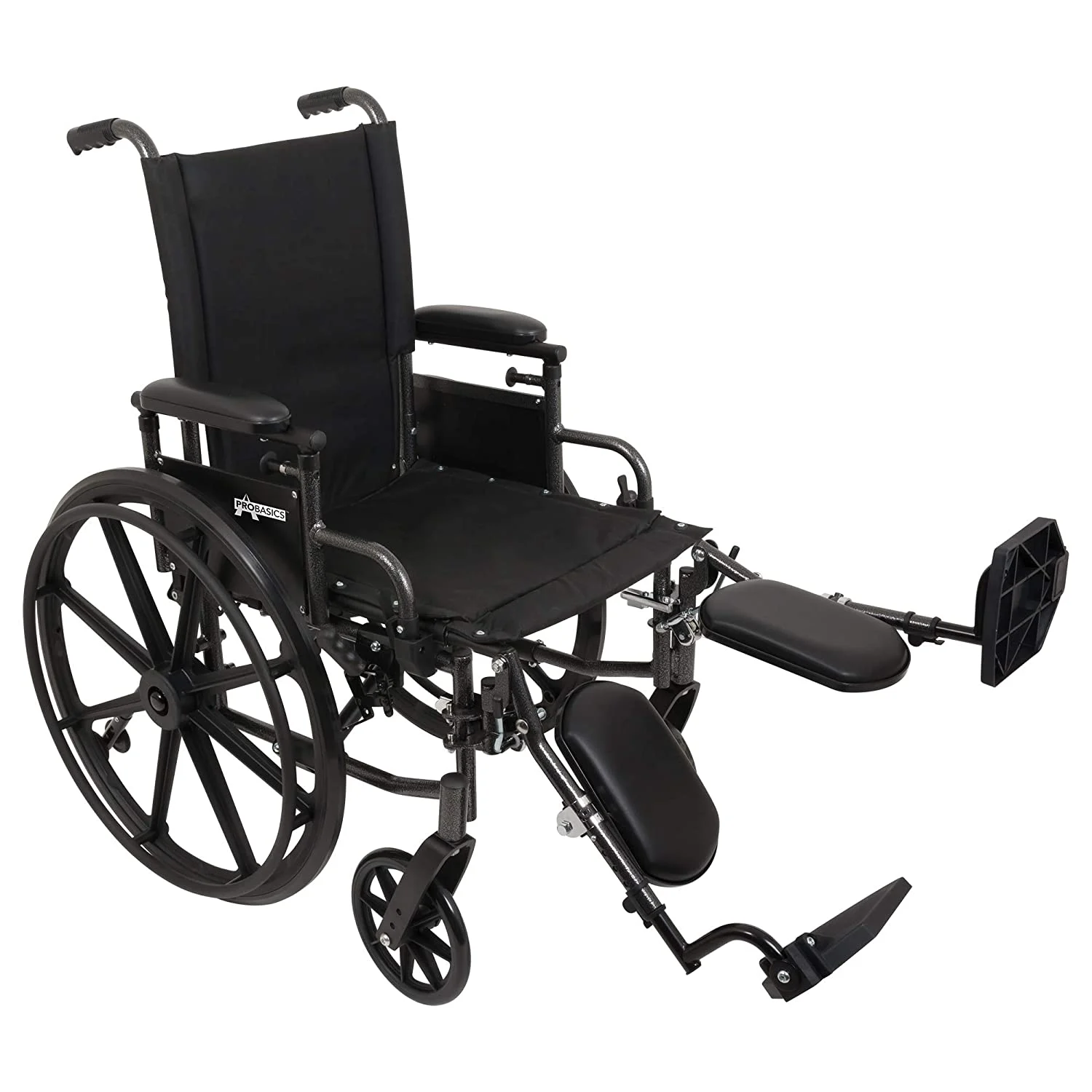
ProBasics Comfort Standard Wheelchair
Features
- Type: manual wheelchair
- Seat size: approximately 20″ W x 16″ D
- Weight limit: approximately 300 lbs
- Armrests: flip-back desk length
- Footrests: swing-away
- Seat: height-adjustable
- Frame: steel
Other features: removable padded armrests; easy-to-clean upholstery; adjustable seating position; folding frame.
The ProBasics Comfort Standard Wheelchair is not the lightest chair here, but its strength is flexibility around fit and transfers. The current configuration combines a 20-inch-wide seat with a height-adjustable seating position, flip-back desk-length armrests and swing-away footrests, making it more adaptable than the stripped-back transport models.
The flip-back arms are particularly useful for seniors who regularly move between the wheelchair and a bed, chair or table. Instead of leaving the armrest fixed in the transfer path, it can be moved out of the way to create better side access.
What do we love it for?
The biggest advantage is the combination of a wider seat and removable transfer-friendly components. For a user who spends more time in the chair and needs easier access to tables or lateral transfers, those features matter more than saving the final few pounds of carrying weight.
The wider seating area also gives it a different role from narrow travel chairs, which can feel cramped for larger users.
What could be better?
This is closer to a conventional standard wheelchair than a true ultralight model, so it is not the chair we’d choose for someone whose main concern is repeatedly lifting it into a car.
A steel frame is durable but naturally heavier than aluminum or magnesium. Buyers should therefore treat this as an adjustable everyday chair with some portability, rather than an ultralight travel wheelchair.
7. Best Lightweight Wheelchair with Removable Arms
Amazon
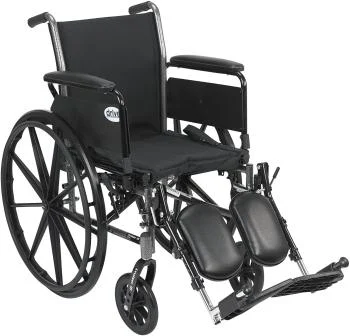
Drive Medical Cruiser III Lightweight Wheelchair
Features
- Type: manual wheelchair
- Seat size: 16” x 19”
- Wheelchair weight: 41 lbs (38 lbs without riggings)
- Weight limit: 350 lbs
- Dimensions: 36.5” x 28” x 32.5”
- Warranty: limited lifetime
Other features: push-to-lock wheel locks; adjustable seat depth; elevating leg rests
A lightweight wheelchair with removable flip-back arms, the Drive Medical K320DFA-ELR Cruiser III Light Weight Wheelchair is quite light at 41 lbs (38 lbs without riggings). It features an adjustable seat depth so you can customize it as you wish to increase the level of comfort. The chair comes with push-to-lock wheel locks for extra safety.
The Drive Medical K320DFA-ELR Cruiser III Light Weight Wheelchair sports a carbon steel frame that allows for custom back inserts and accessories. The large back wheels provide extra stability, and the 8-inch front ones offer a smooth ride no matter the surface.
This chair comes with standard detachable flip back arms and you can choose to use the swing away or elevated footrests. The black nylon upholstery makes for an attractive look and is also very easy to clean.
What are our favorite features? The Drive Medical K320DFA-ELR Cruiser III Light Weight Wheelchair is very comfortable thanks to the adjustable seat depth and it comes with limited lifetime warranty for extra peace of mind.
What could be better? The wheels of the Drive Medical K320DFA-ELR Cruiser III Light Weight Wheelchair might feel a bit wobbly at times.
8. Best Electric Lightweight Wheelchair for Seniors
Amazon
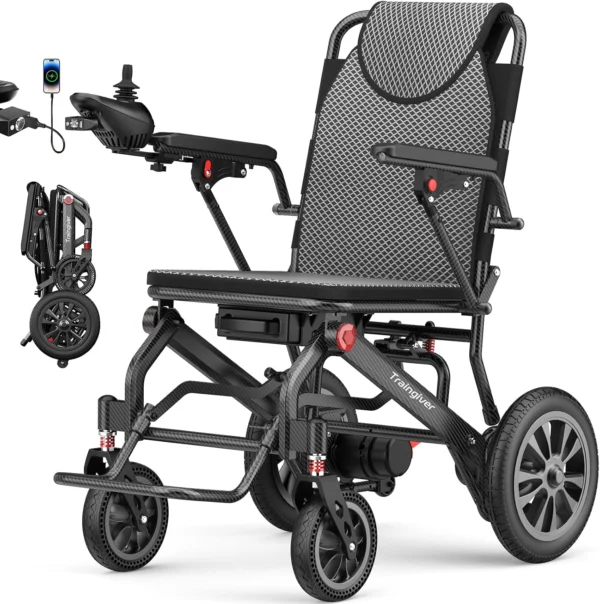
Traingiver Lightweight Foldable Electric Wheelchair
Features
- Type: foldable electric wheelchair
- Wheelchair weight: approximately 38 lbs
- Weight limit: 350 lbs
- Motor power: 500W total
- Claimed travel range: 18+ miles
- Foldable: yes
- Travel positioning: airline-approved listing
Other features: compact folding frame; joystick control; lithium battery; portable motorized design.
The Traingiver Lightweight Electric Wheelchair is a great electric option. You really can’t beat a 38-pound chair weight, 350-pound capacity, 500W power and 18+ mile travel range, which is impressively light for a powered wheelchair at this price point.
The main appeal is obvious: this chair gives users powered mobility without moving into the 60- to 100-pound weights associated with many traditional electric wheelchairs. It also folds for transport and is marketed as airline approved, making it potentially attractive for people who travel regularly.
What do we love it for?
The 38-pound weight is the headline feature. It is still substantially heavier than a manual travel chair, but by electric-wheelchair standards it is very light and much more realistic to load into a vehicle.
The claimed 350-pound capacity and 18+ mile range also give it impressive specifications for such a compact frame.
What could be better?
This is a very new product with only a limited ownership history compared with established mobility brands such as Drive, Medline or Karman. We are not saying it will fall apart, but the reliability over the long term is yet to be tested. While it didn’t run out of battery during the tests, the claimed range of 18 miles is a big ask of such a small chair and hence, we would be skeptical that this is marketing hype and not a real world test result.
Which Type of Lightweight Wheelchair Should You Choose?
The best lightweight wheelchair depends on more than its total weight. For some people, the priority is finding the lightest wheelchair possible for lifting into a car. Others need a small, compact wheelchair for travel or tight spaces, while someone who wants to move independently may need a lightweight manual wheelchair with large rear wheels for self-propulsion.
Lightest Wheelchair for Lifting and Travel
If minimum lifting weight is the priority, start with a transport chair. These chairs use small rear wheels and are designed to be pushed by a caregiver, allowing them to weigh considerably less than many self-propelled wheelchairs.
The Drive Medical Fly Lite weighs around 19 pounds, making it one of the lightest complete transport wheelchairs in this guide. If independent self-propulsion is important, the Karman Ergo Flight is our preferred ultra-lightweight manual wheelchair because it remains around 19.8 pounds without the footrests while retaining large rear wheels.
Don’t compare weight alone. Removable footrests, quick-release rear wheels and batteries can substantially reduce the heaviest piece that actually needs to be lifted.
Portable and Foldable Lightweight Wheelchairs
A portable lightweight wheelchair should be easy to fold, lift and fit into the available vehicle space. Folded dimensions can therefore matter just as much as chair weight.
Transport chairs such as the Drive Medical Fly Lite are particularly useful for frequent vehicle travel because their smaller wheels allow them to fold into a compact package. For users who need to self-propel, the Karman Ergo Flight and Hi-Fortune Lightweight Medical Manual Wheelchair combine folding frames with removable components that make them easier to transport.
A foldable wheelchair is not automatically a lightweight one, so check both the total lifting weight and folded dimensions before buying.
Small and Compact Wheelchairs
People searching for a small wheelchair are often trying to solve a space problem rather than simply reduce weight. If the chair needs to pass through narrow doorways, fit inside a small car or be stored in limited space, check the wheelchair’s overall open width and folded dimensions as well as its weight.
Transport wheelchairs are often more compact because they don’t have the large rear wheels required for self-propulsion. However, seat width still needs to suit the user. Choosing a wheelchair that is too narrow simply to reduce its overall size can compromise comfort and fit.
Lightweight Wheelchairs That Are Easy to Push
A lighter chair can reduce the amount of weight a caregiver needs to move, but the easiest wheelchair to push isn’t necessarily the lightest wheelchair. Wheel diameter, tires, bearings, user weight and the surface all affect rolling resistance.
For caregiver-assisted use, a transport chair with attendant handbrakes can be particularly convenient. The Medline Lightweight Transport Wheelchair provides push-handle brakes and larger 12-inch rear wheels, which can make it easier to control than very small-wheel transport chairs on everyday outdoor surfaces.
For independent users, a lightweight self-propelled wheelchair such as the Karman or Hi-Fortune provides large rear wheels that the seated user can reach themselves.
What Counts as a Lightweight Wheelchair?

There is no single universal weight at which a wheelchair officially becomes “lightweight.” The term is used across several very different types of chairs, which is why a 15-pound transport chair and a 38-pound electric wheelchair may both be marketed as lightweight products. The more useful comparison is with other wheelchairs in the same category.
The actual weight varies widely by design, which we explain in more detail in our guide to how much wheelchairs weigh. A lightweight transport chair can weigh under 20 pounds because it does not need the large rear wheels required for self-propulsion. A manual self-propelled wheelchair normally weighs more, while electric wheelchairs add motors, batteries and control systems that substantially increase their weight.
For seniors and caregivers, it is also worth looking beyond the advertised total. Some wheelchairs allow the footrests, rear wheels, cushions or battery to be removed before lifting, substantially reducing the heaviest single piece that needs to be placed into a vehicle. The Karman Ergo Flight Ultra Lightweight is a good example: its overall weight is already low, but removing the rear wheels and footrests makes the remaining frame lighter again.
Ultra-Lightweight Wheelchairs
For the purposes of this guide, chairs weighing less than about 20 pounds fall into our ultra-lightweight group. This is where transport chairs tend to dominate, because removing self-propelling rear wheels saves considerable weight. The Karman Ergo Flight stands out because it manages to remain around this range while still providing large rear wheels for independent propulsion.
These models make the most sense where lifting and vehicle transport are frequent considerations. The trade-off is that very lightweight chairs may have fewer adjustments, smaller wheels or lower maximum capacities than heavier everyday models.
Standard Lightweight Wheelchairs
Wheelchairs in roughly the 20-to-40-pound range offer more room for larger wheels, adjustable seating components and heavier-duty construction. The Hi-Fortune Lightweight Medical Manual Wheelchair sits at the low end of this range, while chairs such as the ProBasics Ultra Lightweight Wheelchair and Drive Medical Cruiser III move toward the heavier end.
For many people, this category offers the best compromise between portability and everyday usability. A 30-pound chair isn’t effortless to lift, but it can still be considerably easier to manage than a heavier traditional wheelchair while retaining more of the features expected from a full-size manual chair.
Lightweight Electric Wheelchairs
Electric wheelchairs are a different proposition because batteries and motors add substantial weight. A powered chair weighing around 35–50 pounds can therefore legitimately be considered lightweight compared with many conventional power wheelchairs.
The Traingiver Lightweight Electric Wheelchair, at around 38 pounds, demonstrates just how much lighter folding electric chairs have become. That still doesn’t mean a 38-pound chair will be easy for everyone to lift, so anyone buying one for vehicle travel should check the total lifting weight, removable battery and folded dimensions rather than relying solely on the word “lightweight.”
Key Features to Consider When Buying a Lightweight Wheelchair
The best lightweight wheelchair isn’t necessarily the one with the lowest number on the scale. Reducing weight usually involves some compromise in wheel size, seating features, capacity or adjustability, so the right chair depends on who will use it and how it will be transported.
Wheelchair configuration also affects stability, maneuverability and the effort required to propel the chair. Clinical wheelchair guidance emphasizes balancing these characteristics rather than simply maximizing one specification.
Manual vs Transport vs Electric: Which Is Right for You?
There are three main types represented in this guide: self-propelled manual wheelchairs, transport wheelchairs and electric wheelchairs. Many of the lightweight self-propelled options overlap with models covered in our best manual wheelchairs comparison, but transport chairs serve a fundamentally different purpose.
A self-propelled manual wheelchair has large rear wheels that the seated user can reach and push. This can provide greater independence for someone with sufficient upper-body strength, but those large wheels add weight and bulk when the chair is transported. The Karman Ergo Flight and Hi-Fortune Lightweight Medical Manual Wheelchair are examples of lightweight chairs that still retain this self-propulsion capability.
A transport wheelchair uses much smaller rear wheels and is designed primarily to be pushed by a caregiver. Removing the large self-propelling wheels allows manufacturers to make these chairs extremely light and compact, which is why models such as the Medline Ultralight Transport and Drive Medical Fly Lite are so attractive for appointments and travel.
Electric wheelchairs add a third option for users who cannot or do not want to propel themselves manually. A model such as the Traingiver Lightweight Electric Wheelchair can provide much greater independent mobility over distance, but even lightweight electric chairs are significantly heavier than manual transport chairs and require consideration of charging, battery handling and airline requirements.
Seat Size and Fit
Seat dimensions matter just as much as wheelchair weight. A seat that is too narrow can be uncomfortable and create unwanted pressure, while one that is unnecessarily wide may make propulsion harder and increase the overall width of the wheelchair.
Pay attention to seat width, seat depth and seat-to-floor height, particularly if the wheelchair will be used for extended periods rather than occasional trips. Armrest height, backrest support and footrest positioning also contribute to comfort and posture.
If a person relies on a wheelchair for much of the day, proper seating and configuration become increasingly important. A physical or occupational therapist, seating specialist or other appropriately qualified mobility professional can help assess individual positioning needs.
Transport Weight vs Everyday Wheelchair Weight
This is one specification we think should receive far more attention. Manufacturers may quote a chair’s total assembled weight, a weight without footrests or even a frame-only weight after the rear wheels have been removed. All of those numbers can be useful, but they describe different things.
If the wheelchair will frequently be loaded into a car, ask what is the heaviest piece I actually need to lift? The Karman Ergo Flight, for example, becomes considerably lighter after its footrests and quick-release rear wheels are removed. The Drive Medical Fly Lite likewise allows its footrests to be removed before loading.
A chair that breaks down into lighter components may therefore be easier for a caregiver to manage than a supposedly lighter wheelchair that needs to be lifted as one complete unit.
Folded Size
A wheelchair can be lightweight and still be awkward to fit inside a vehicle. Check the folded width, height and length against the actual space available in your trunk or cargo area rather than assuming that “foldable” automatically means compact.
Transport chairs usually perform particularly well here because their small wheels allow them to fold into a narrow package. The Drive Medical Fly Lite, for example, combines a folding frame with a folding backrest and removable footrests.
Electric wheelchairs require extra care because the folded frame still contains motors and other components. With the Traingiver Lightweight Electric Wheelchair, check both its folded size and whether its approximately 38-pound lifting weight is manageable for whoever will regularly load it.
Materials and durability
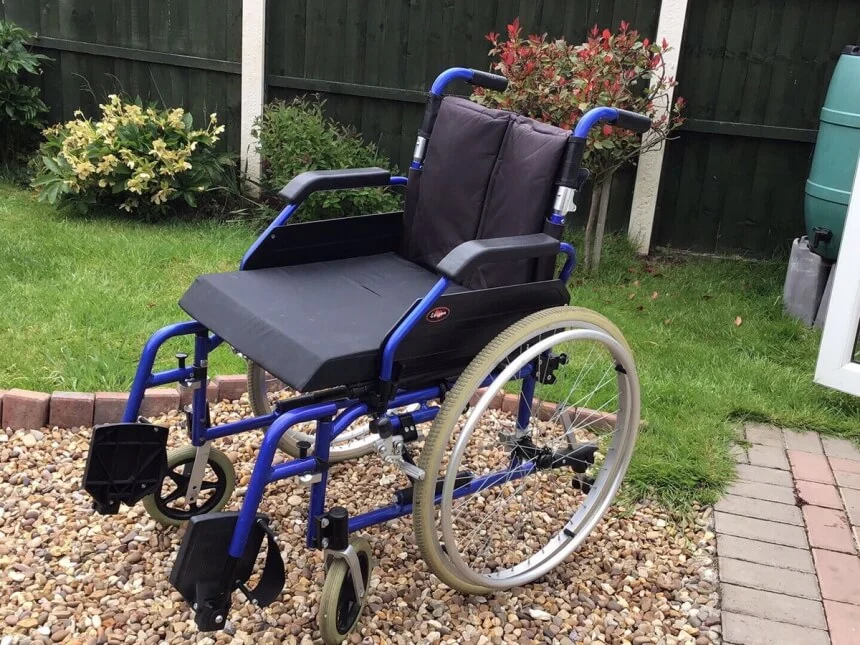
Aluminum is common in lightweight wheelchairs because it offers a useful combination of strength, corrosion resistance and low weight. Premium ultralight chairs may use aircraft-grade aluminum, magnesium alloys or even carbon fiber to reduce weight further.
Frame material alone does not determine quality, however. Cross-bracing, wheel hardware, bearings, upholstery, brakes and fasteners all influence how the wheelchair performs over time.
The Karman Ergo Flight uses 6061 T-6 aircraft-grade aluminum, while the Hi-Fortune Lightweight Medical Manual Wheelchair uses a magnesium-alloy frame. Heavier models such as the Drive Medical Cruiser III use steel construction, accepting additional weight in exchange for a more traditional configurable wheelchair platform.
Weight Capacity
The wheelchair’s stated maximum weight capacity should always comfortably accommodate the intended user. Most of the lightweight models in this guide fall somewhere between roughly 220 and 350 pounds, but capacity varies by exact model and seat-width configuration.
Don’t assume that a higher capacity automatically means a better wheelchair. Increasing load capacity can require additional material and reinforcement, which often makes the chair heavier. The Drive Medical Cruiser III is a good example of the trade-off: it provides higher-capacity configurations but is considerably heavier than the ultralight Karman.
The aim is to select a capacity appropriate to the user while still achieving the portability and features you actually need.
Armrests and Leg Rests
Armrest and footrest design can have a surprisingly large impact on daily usability. Fixed arms are simple and strong, but flip-back or removable arms can make transfers easier and allow the wheelchair to move closer to a dining table or desk.
This is where the Drive Medical Cruiser III has an advantage, with removable flip-back arms designed around easier access and transfers. The ProBasics Ultra Lightweight Wheelchair also provides more adjustment than the very lightweight travel chairs.
Likewise, swing-away footrests can make standing transfers easier because they move out of the path of the user’s feet. Elevating leg rests provide additional positioning options for some users but add weight and bulk, so they aren’t automatically preferable for a chair being bought primarily for travel.
Wheels and Maneuverability

Large rear wheels give a manual-wheelchair user the ability to self-propel, but they make the chair wider and heavier. Small-wheel transport chairs remove that option but can be much easier for caregivers to load into vehicles and maneuver through tight indoor spaces.
Wheel diameter also affects how easily a chair rolls across uneven surfaces. Larger wheels generally cope better with small cracks, transitions and rough paving, while tiny transport-chair casters are best suited to smooth indoor floors and maintained sidewalks.
That distinction is important when comparing something like the Karman Ergo Flight with the Drive Medical Fly Lite. The Fly Lite is considerably easier to carry, but the Karman’s large rear wheels make it far more suitable for a user who wants to propel themselves.
Brakes and Caregiver Controls
A wheelchair’s braking system should match the way it will be used. Self-propelled manual wheelchairs commonly use wheel locks that hold the chair stationary during transfers, while transport models may add attendant-operated brake levers to the push handles.
Handbrakes can be particularly useful for caregivers on slopes because they provide more direct control from behind the chair. The exact braking arrangement varies by model, so it is worth checking whether the chair offers only parking-style wheel locks or additional caregiver controls before purchasing.
Whatever the design, wheel locks and attendant brakes aren’t necessarily intended to perform exactly the same function. Follow the manufacturer’s instructions and make sure the caregiver understands how the braking system operates before using the chair on gradients.
Warranty and Support
Warranty periods vary considerably between manufacturers, and the frame may have different coverage from upholstery, wheels, batteries or electronic components. A “limited lifetime warranty” often applies only to specific structural parts rather than everything attached to the chair.
Established manufacturers can also offer an advantage in manuals, replacement components and technical support. This becomes increasingly important with an electric wheelchair such as the Traingiver Lightweight Electric Wheelchair, where batteries, controllers and motors introduce components that simply don’t exist on a basic transport chair.
Rather than choosing solely on the longest advertised warranty, check what is actually covered, for how long and how warranty service is handled.
Cost and Medicare Coverage
Lightweight-wheelchair prices vary widely because this category includes basic transport chairs, premium ultralight manual wheelchairs and folding electric models. A simple caregiver-pushed chair can cost a few hundred dollars, while specialized ultralight or powered mobility equipment can cost considerably more.
Online pricing also changes regularly, so we don’t recommend using rigid price bands as the main way to choose a wheelchair. Fit, function and whether the chair will actually meet the user’s mobility needs matter much more than whether it sits within a particular retail category.
Does Medicare Cover Lightweight Wheelchairs?
Medicare Part B can cover wheelchairs as durable medical equipment when Medicare’s eligibility and medical-necessity requirements are met. It is not simply a case of buying any wheelchair online and claiming back 80% of the price. Medicare requires medically necessary DME to be ordered for use in the home, and both the treating provider and DME supplier need to meet Medicare requirements.
After the Part B deductible is met, the beneficiary generally pays 20% of the Medicare-approved amount when the supplier accepts assignment. Depending on the equipment, Medicare may cover purchase, rental or provide a choice between the two.
Power wheelchairs have additional requirements. Medicare states that power wheelchairs and scooters must be medically necessary, require appropriate documentation, and some power-wheelchair models may require prior authorization before coverage is approved.
If you’re considering Medicare coverage, speak with your treating provider and a Medicare-enrolled DME supplier before purchasing the chair. Medicare Advantage plans may use different supplier networks and cost-sharing arrangements, so members should also check directly with their plan.
Private insurance rules vary considerably. Prior authorization, medical documentation and use of an approved supplier may be required, so contact the insurer before making a significant purchase if reimbursement is important.
Which Portable Lightweight Wheelchair Is Best for Travel?
For caregiver-assisted travel, a lightweight, foldable transport wheelchair is usually the most portable option because its smaller wheels reduce both weight and folded bulk. The Medline Ultralight Transport and Drive Medical Fly Lite are two of the strongest options in this guide because both prioritize low lifting weight and compact folding. The Medline is particularly attractive where keeping the chair as light as possible is the priority, while the Fly Lite combines low weight with a folding backrest and removable footrests.
If the user needs to self-propel independently, the Karman Ergo Flight is more appropriate because it retains large rear wheels while remaining exceptionally light for a manual wheelchair. An electric model such as the Traingiver Lightweight Electric Wheelchair can provide even greater independence, but its battery, total lifting weight and airline requirements need to be considered before travel.
Lightweight Wheelchairs FAQ
What’s the Lightest Wheelchair in Our Review?
The Medline Ultralight Transport, at around 14.8 pounds in the configuration reviewed here, is the lightest complete wheelchair in our selection. However, it achieves that weight partly because it is a transport chair designed to be pushed by another person rather than a conventional self-propelled manual wheelchair.
The Karman Ergo Flight is more impressive if independent propulsion is important because it weighs around 19.8 pounds without footrests while retaining full-size rear wheels. The “lightest” chair is therefore not necessarily the best one unless it also suits the way the user needs to move around.
What’s the Difference Between a Lightweight and Ultra-Lightweight Wheelchair?
There is no single universally applied retail definition, but ultra-lightweight generally refers to chairs designed more aggressively around weight reduction. In this guide, we use roughly 20 pounds as a practical dividing point, while standard lightweight manual chairs generally fall somewhere above that.
The distinction becomes less meaningful once you compare different wheelchair types. A 19-pound transport chair and a 20-pound self-propelled chair offer very different capabilities, while a 38-pound electric wheelchair can still be exceptionally light within its own category.
The best approach is therefore to compare weight within the type of wheelchair you actually need.
Can Seniors Self-Propel a Lightweight Wheelchair?
Yes. Lightweight wheelchairs are not all transport chairs.
Models such as the Karman Ergo Flight and Hi-Fortune Lightweight Medical Manual Wheelchair use large rear wheels that allow the seated user to propel themselves, provided they have the necessary strength, range of motion and wheelchair skills. Their relatively low frame weight can also reduce some of the effort involved in moving the chair.
Transport models such as the Drive Medical Fly Lite use much smaller rear wheels and are intended to be pushed by another person. Before buying, always check the wheel configuration rather than assuming every chair described as a “manual wheelchair” can be independently propelled.
How Do I Know Whether a Lightweight Wheelchair Will Be Durable Enough?
Frame construction and weight capacity are useful starting points, but they are not the only indicators of durability. Look at the quality of the cross-bracing, wheels, casters, armrest fittings, brakes and upholstery, along with the manufacturer’s warranty and availability of replacement parts.
Established mobility brands can have an advantage because replacement components and technical information may remain available long after purchase. A very inexpensive ultralight chair can still be suitable for occasional travel, but someone who uses a wheelchair every day may place greater value on adjustability, repairability and long-term support.
Which Lightweight Wheelchairs Are Easiest to Push?
The easiest lightweight wheelchair to push depends on who is propelling it and where it will be used. A lighter chair can reduce the weight being moved, but wheelchair propulsion depends on much more than chair weight alone.
Wheel size, tire type, bearing condition, axle position, user weight, seating position and the surface all influence rolling resistance and maneuverability. A very lightweight transport chair with small wheels may therefore be easier to lift into a car but less comfortable to push across rough ground than a somewhat heavier chair with larger wheels.
For example, the Drive Medical Cruiser III is much heavier than the Fly Lite but offers the large-wheel configuration expected from a conventional self-propelled wheelchair.
What’s the Typical Weight Capacity for a Lightweight Wheelchair?
Many lightweight wheelchairs support somewhere between 250 and 300 pounds, although some ultralight models are rated lower and heavier lightweight models may reach 350 pounds or more. The exact capacity should always be checked for the specific seat width and configuration being purchased.
The Drive Medical Cruiser III, for example, is available in higher-capacity configurations than the ultralight Karman Ergo Flight. Allowing a sensible margin below the maximum rating is preferable to choosing a chair where the intended user’s weight sits right at the published limit.
How Long Does a Lightweight Wheelchair Last?
There isn’t a reliable universal lifespan for a lightweight wheelchair because longevity depends heavily on how often it is used, user weight, terrain, storage, maintenance and build quality. A chair used occasionally for appointments may experience very different wear from one used for several hours every day.
Rather than expecting a fixed number of years, inspect the wheelchair regularly for loose fasteners, worn tires or casters, damaged upholstery, brake problems and changes in folding mechanisms. Follow the manufacturer’s maintenance instructions and have safety-related problems repaired before continuing to use the chair.
A long frame warranty is reassuring, but it should not be interpreted as a guarantee that every component will last for the same period.
Should I Choose the Lightest Wheelchair Possible?
Not automatically. Every reduction in weight potentially involves a trade-off somewhere else, whether that is smaller wheels, fewer adjustments, lower capacity or greater cost.
If the wheelchair is lifted into a vehicle several times a week, shaving ten pounds from the chair can be enormously valuable. This is where models such as the Medline Ultralight Transport, Drive Medical Fly Lite and Karman Ergo Flight make particularly strong arguments.
If the chair remains unfolded at home most of the time, seating comfort, fit, maneuverability and transfer features may matter considerably more. The goal should therefore be to find the lightest chair that still performs all of the functions the user actually needs, rather than simply buying the lowest weight specification.
Our Verdict
Choosing the best lightweight wheelchair comes down to matching the chair’s capabilities to the user rather than simply choosing the lowest weight. A transport wheelchair can be incredibly easy to lift but requires a caregiver, while a self-propelled manual chair preserves more independence at the cost of larger wheels and some additional bulk.
For most people looking for an exceptionally portable self-propelled wheelchair, the Karman Ergo Flight Ultra Lightweight Wheelchair remains our Editor’s Choice. At around 19.8 pounds without the footrests on its smaller configurations, it provides an unusual combination of low lifting weight, large rear wheels and an aircraft-grade aluminum frame. Its removable rear wheels and footrests also allow caregivers to reduce the weight even further before placing it into a vehicle.
If travel with a caregiver is the main priority, the Medline Ultralight Transport provides an even lighter solution by removing the large self-propulsion wheels. The Drive Medical Fly Lite is another strong travel choice, while the Hi-Fortune Lightweight Medical Manual Wheelchair offers good value for someone who wants to maintain self-propulsion without moving into premium ultralight pricing.
The heavier Medline MDS806550E, ProBasics Ultra Lightweight Wheelchair and Drive Medical Cruiser III make sense when adjustability and everyday wheelchair features are more important than achieving the absolute minimum lifting weight. They are still easier to manage than many older full-size wheelchairs but provide more conventional seating and transfer options.
For powered mobility, the Traingiver Lightweight Electric Wheelchair provides a very different type of portability. At around 38 pounds it is substantially heavier than any of the manual travel chairs, but remarkably light compared with traditional electric wheelchairs. As with any folding power chair, users should consider the actual lifting weight, battery requirements, range and manufacturer support rather than assuming “lightweight” automatically means easy to transport.
Ultimately, think first about who will propel the wheelchair, how often it needs to be lifted, where it will be used and how long the user will sit in it. For occasional appointments and travel, portability may dominate the decision. For daily use, seating fit, wheel configuration, transfer access and comfort become much more important.
A wheelchair is also a piece of mobility equipment that directly affects posture, safety and independence. Where the user has complex mobility, positioning or medical needs, advice from a physical therapist, occupational therapist or wheelchair/seating specialist can be far more valuable than simply comparing product specifications online.
References
- Keys to manual wheelchair configuration | Agency for Clinical Innovation
The configuration of a manual wheelchair must achieve a balance between wheelchair stability, manoeuvrability and the preservation of the client’s upper limb function.
aci.health.nsw.gov.au - Will Medicare cover the cost of wheelchairs and walkers? | medicareresources.org
Q: Will Medicare cover the cost of wheelchairs and walkers? A: Yes.
www.medicareresources.org - Featherweight Wheelchair – World’s Lightest at 13.5 lbs – Feather Mobility.