
Amazon
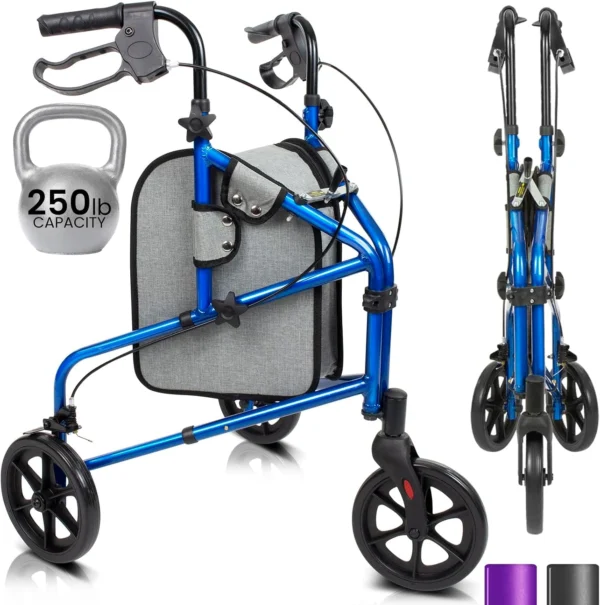
Vive Mobility 3-Wheel Rollator
Features
- Weight: approximately 11 lbs
- Weight capacity: 250 lbs
- Wheel size: 8″
- Handle height: approximately 31.5″–38″
- Folded width: approximately 9″
- Frame: aluminum
- Brakes: ergonomic locking hand brakes
- Seat: none
More features: three-wheel configuration; narrow turning circle; removable storage bag; adjustable handles; folds flat for vehicle transport.
The Vive 3-Wheel Rollator is the walker we’d choose when maneuverability matters more than having a seat. At just 11 pounds, it is exceptionally easy to lift and transport. More importantly, the three-wheel design gives it a much tighter turning circle than conventional four-wheel rollators. It can pivot through kitchens, narrow hallways, shop aisles and crowded spaces where a wide seated walker can become frustrating.
The frame collapses to around 9 inches wide, making it easy to store in a car or against a wall. Handle height adjusts from roughly 31.5 to 38 inches, and the large 8-inch wheels are considerably more capable over thresholds than the tiny casters found on some indoor walkers.
What we liked
The Vive is wonderfully nimble when we tested it out around our hallways and corridors. It changes direction with very little effort and can be partially narrowed when moving through especially tight spaces. That makes it feel far less cumbersome than a conventional rollator inside a small home.
At 11 pounds, we found that it is also one of the easiest walkers here to lift into a car. The storage bag is larger than expected and sits conveniently between the side frames.
What could be better
The trade-off is stability and this was certainly noticeable with some of our older people. A three-wheel rollator has a smaller support footprint than a four-wheel model, so it is not our preferred choice for someone with significant balance impairment or someone who needs to place substantial body weight through the walker.
There is also the obvious issue of no seat, which immediately rules it out for users who need frequent seated rest breaks. This is therefore best viewed as a lightweight maneuverability aid, not a substitute for a highly stable four-wheel or standard walker where maximum support is needed.