
Recovering from a foot, ankle or lower-leg injury can make everyday movement much harder, particularly if you have been instructed to keep weight off the affected limb. Crutches can work well, but some people find them tiring or awkward over longer distances, which is where a knee scooter may offer a practical alternative.
A knee scooter supports the injured leg on a padded platform while you propel yourself with the uninjured leg. This can make it easier to move around the home, workplace or other level environments during recovery, provided your doctor or rehabilitation professional has confirmed that a knee scooter is appropriate for your injury.
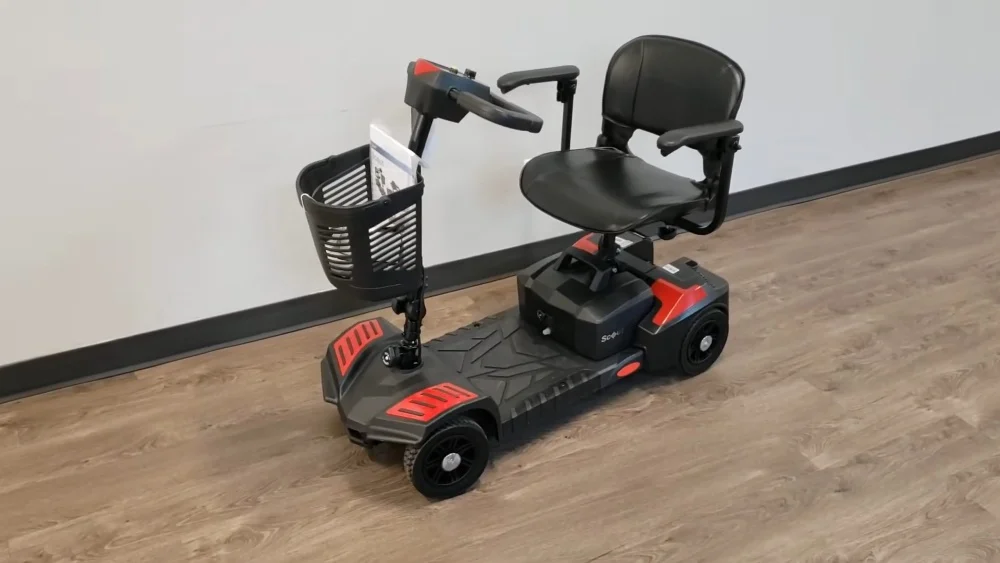
For longer-term mobility needs, a knee scooter serves a very different purpose from a seated mobility scooter. Our guide to mobility scooters for seniors explains when a powered seated scooter may be the more practical option.
When choosing the best knee scooters for this guide, we looked at factors such as knee-platform comfort, handlebar and pad adjustability, wheel size, braking, portability, weight capacity and ease of transport. We also included compact folding models, lightweight standard scooters and larger all-terrain options for people who expect to use their scooter outdoors.
SeniorFitness is reader-supported. We may earn a commission through products purchased using links on this page. Learn more about our process here
Quick Summary
- Best Portable Knee Scooter:KneeRover GO HYBRID — A compact folding knee scooter with 9-inch pneumatic front tires, a 300-pound capacity and a design built around easier transport and storage.
- Premium Pick – Best Heavy-Duty All-Terrain Knee Scooter:KneeRover QUAD All Terrain Knee Scooter — A substantial outdoor-oriented model with large pneumatic tires, tie-rod steering and a 350-pound capacity.
- Best Everyday Knee Scooter:Vive Mobility Knee Walker — A versatile standard knee scooter with 8-inch wheels, adjustable knee support, folding frame and 300-pound capacity for everyday indoor and paved-surface use.
- Best Value Knee Scooter:BlessReach All-Terrain Knee Walker — A value-focused large-wheel scooter with an adjustable steel frame, storage bag and 300-pound capacity.
- Best All-Terrain Knee Scooter:Vive Mobility All Terrain Knee Scooter — A four-wheel all-terrain model with 12-inch pneumatic tires, a 350-pound capacity and generous height adjustment for outdoor use.
- Best Lightweight Standard Knee Scooter:BodyMed Knee Walker — A compact standard knee walker weighing approximately 20 pounds, with a 300-pound capacity, detachable basket and smaller wheels suited to smooth surfaces.
6 Best Knee Scooters Review
1. Best Portable Knee Scooter
Amazon
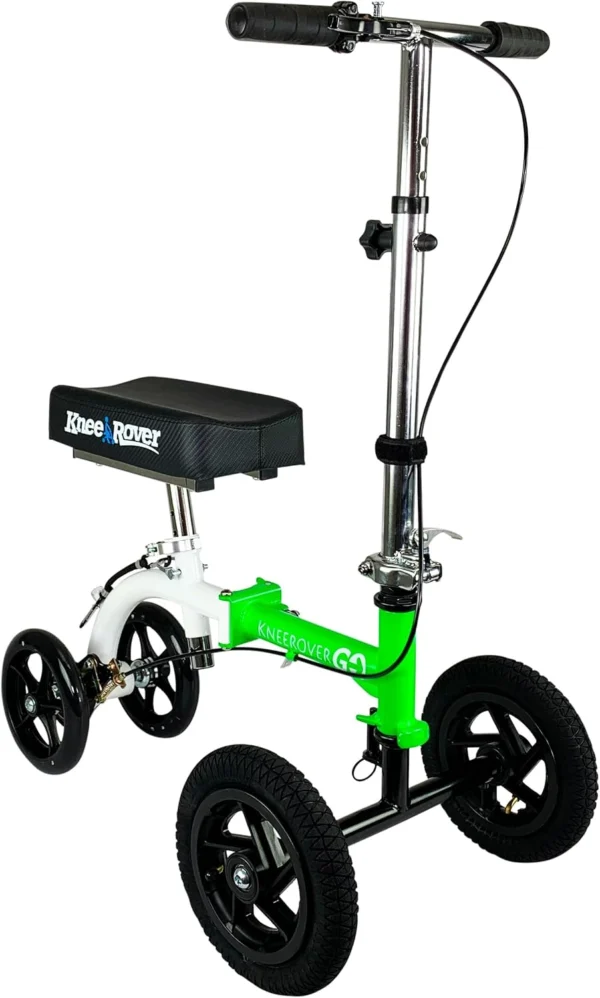
KneeRover GO HYBRID
Features
- Weight capacity: 300 lbs
- Product weight: 22.5 lbs
- Handlebar height: 31.5″ – 41″
- Knee support height: 16.5″ – 23″
- Knee pad: 12.5″ x 7″ x 3″
- Front wheels: 9″ air-filled
- Rear wheels: 7.5″ non-marking rubber
- Recommended user height: approximately 4’9″ – 6’6″
More features: compact folding frame; rear drum brakes; tool-free setup; ergonomic grips; compatible with either left or right leg injuries.
The KneeRover GO HYBRID is our top portable choice because its design is built around compact storage and transport without stripping away the features that make a knee scooter practical. It folds down to approximately 20 inches long and weighs 22.5 pounds, making it easier to fit into smaller vehicles, offices or other tight storage spaces than many full-size all-terrain models.
Its two 9-inch pneumatic front tires also give it more outdoor capability than a typical compact scooter with small solid wheels. The rear 7.5-inch wheels keep the footprint manageable, while the knee platform and handlebar have enough adjustment to accommodate users from approximately 4’9″ to 6’6″.
What do we love it for?
Portability is the obvious strength. The GO HYBRID folds quickly and has a relatively short 28.5-inch overall length, which makes it a particularly useful option for someone who expects to move the scooter frequently between home, work and a vehicle.
We also like that KneeRover has not made it purely an indoor travel model. The larger air-filled front tires provide more cushioning over pavement joints and minor surface irregularities than small hard wheels.
What could be better?
At 22.5 pounds, it is compact rather than genuinely lightweight. Someone with limited upper-body strength may still find lifting it into a vehicle difficult, particularly while also protecting an injured leg.
The pneumatic front tires also need more maintenance than solid wheels. Tire pressure should be checked regularly, and punctures remain possible.
2. Premium Pick: Best Heavy-Duty All-Terrain Knee Scooter
Amazon
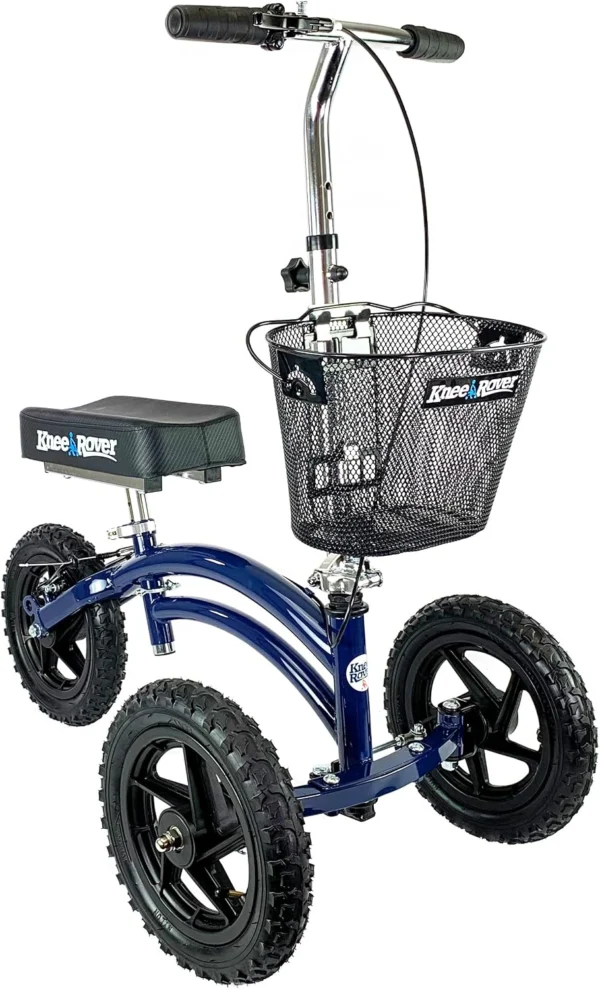
KneeRover QUAD All Terrain Knee Scooter
Features
- Weight capacity: 350 lbs
- Product weight: approximately 26–27 lbs
- Handlebar height: approximately 34″ – 41″
- Knee support height: approximately 18″ – 22″
- Knee pad: 12.5″ x 7″ x 3″
- Wheels: three 12″ air-filled tires
- Recommended user height: approximately 5’6″ – 6’6″
- Foldable: yes
More features: tie-rod steering; rear braking system; thick contoured knee platform; detachable storage basket; folding handlebars.
The KneeRover All Terrain is the most substantial outdoor-oriented model in this lineup. KneeRover specifies a 350-pound capacity and three large 12-inch air-filled tires, which give it significantly more ability to roll over grass, gravel and uneven pavement than a standard knee scooter with 7- or 8-inch wheels.
That rugged setup does make the scooter larger and heavier, but the trade-off is greater stability and wheel clearance for users who expect to spend more time outdoors. The thick 3-inch contoured knee platform and adjustable handlebars also make it better suited to longer periods of use than many basic economy models.
What do we love it for?
The large pneumatic tires are the standout feature. They provide more cushioning and make the scooter less likely to stop abruptly at cracks, stones or rough transitions than a small-wheel model.
We also like the higher 350-pound capacity, which gives this model more margin for larger users than the typical 300-pound knee scooter. The folding handlebars and included basket add some practicality despite the larger frame.
What could be better?
This is a bulky scooter. At roughly 26–27 pounds and more than 35 inches long, it is not the easiest model to lift, fit into a compact vehicle or maneuver through very tight indoor spaces.
The air-filled tires also require ongoing pressure checks and can puncture. If you primarily stay indoors however, you may be better served by a smaller solid-wheel scooter.
3. Best Everyday Knee Scooter
Amazon
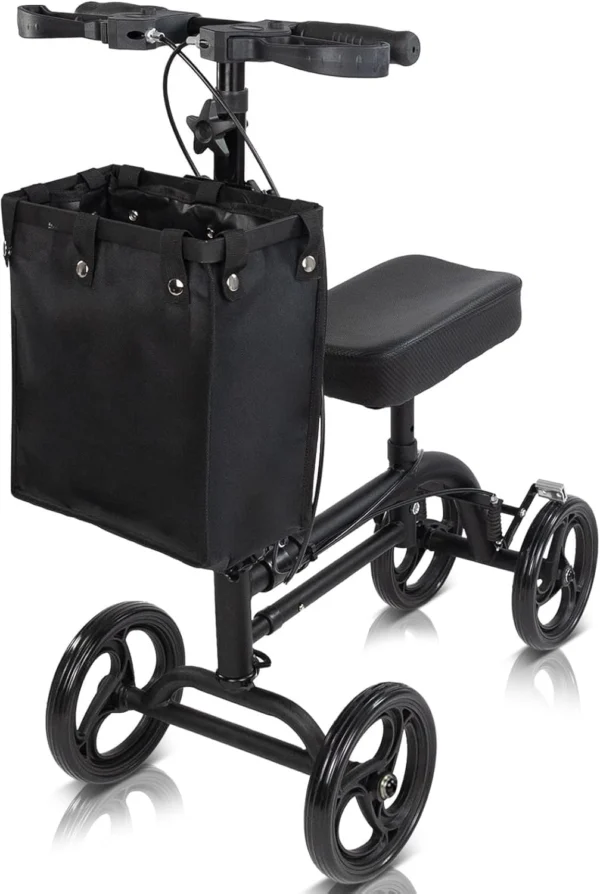
Vive Mobility Knee Walker
Features
- Weight capacity: up to 300 lbs
- Product weight: approximately 24 lbs
- Handlebar height: approximately 33″ – 42″
- Knee platform height: approximately 16.5″ – 20.5″
- Wheel size: 8″
- Frame: alloy steel
- Foldable: yes
- Warranty: 1-year guarantee
More features: contoured foam knee cushion; cloth storage bag. Comes in Black, Pink and Blue
The Vive Mobility Knee Scooter is the most balanced everyday option in this group. The standard 8-inch-wheel design is compact enough for indoor use, shopping centers and smooth paved areas, while still providing a 300-pound capacity and enough adjustability to suit a broad range of users.
At approximately 24 pounds, it sits around the middle of the category for carrying weight. That makes it heavier than the BodyMed but less cumbersome than some of the large all-terrain KneeRover models.
What do we love it for?
The Vive does not try to specialize too heavily in one area, which is precisely why it makes a good everyday choice. The combination of 8-inch wheels, adjustable knee support, folding frame and 300-pound capacity should suit many people recovering from a temporary foot or lower-leg injury.
Vive also provides clearer product documentation and support than many generic marketplace brands. That is useful when you need setup guidance, replacement components or help adjusting the scooter correctly.
What could be better?
The 8-inch wheels are best suited to smooth floors, sidewalks and maintained paved surfaces. They do not provide the same ability to roll over grass, gravel or rough paths as the larger-wheel all-terrain models.
Its approximately 24-pound weight is also worth considering if the scooter will regularly need to be lifted into a car. A more compact or lighter model may be preferable when portability is the main concern.
4. Best Value Knee Scooter
Amazon
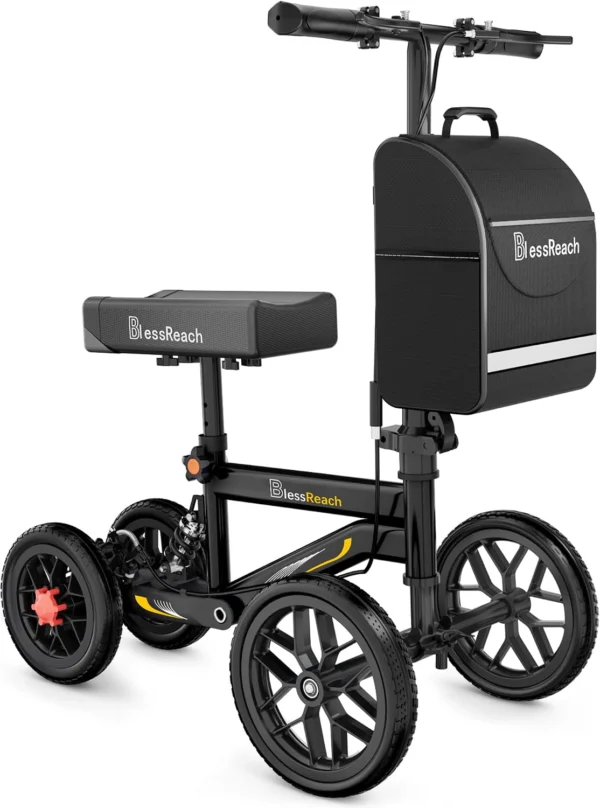
BlessReach All-Terrain Knee Walker
Features
- Weight capacity: 300 lbs
- Product weight: approximately 24.25 lbs
- Wheel size: approximately 11″
- Frame: carbon steel
- Dimensions: approximately 32″ x 17″ x 39″
- Storage: removable bag
- Brakes: hand-operated braking system
More features: large PU wheels; adjustable height; padded knee platform; steerable design; storage bag; approximately 300-pound capacity.
The BlessReach All-Terrain Knee Walker provides a lot of the features people normally associate with more expensive outdoor knee scooters while staying in the value end of the category. Its large 11-inch wheels, 300-pound capacity and padded knee platform give it more versatility than many basic economy scooters with small hard wheels.
At approximately 24.25 pounds, it is not especially light, but that is reasonable given the larger wheels and steel construction. The removable storage bag is also useful because it allows the user to carry small items while keeping both hands available for steering and braking.
What do we love it for?
Value is the main attraction. You get a large-wheel design, adjustable frame, hand braking and storage without immediately moving into the premium KneeRover price bracket.
The 11-inch wheels also give it a more useful outdoor capability than many low-cost knee scooters. For someone who wants a reasonably versatile recovery scooter without paying premium-brand prices, it is a strong contender.
What could be better?
The larger wheels and steel frame make it less compact than a simple indoor knee scooter. Buyers mainly using it inside a home or office may not need the extra bulk.
5. Best All-Terrain Knee Scooter for Seniors
Amazon
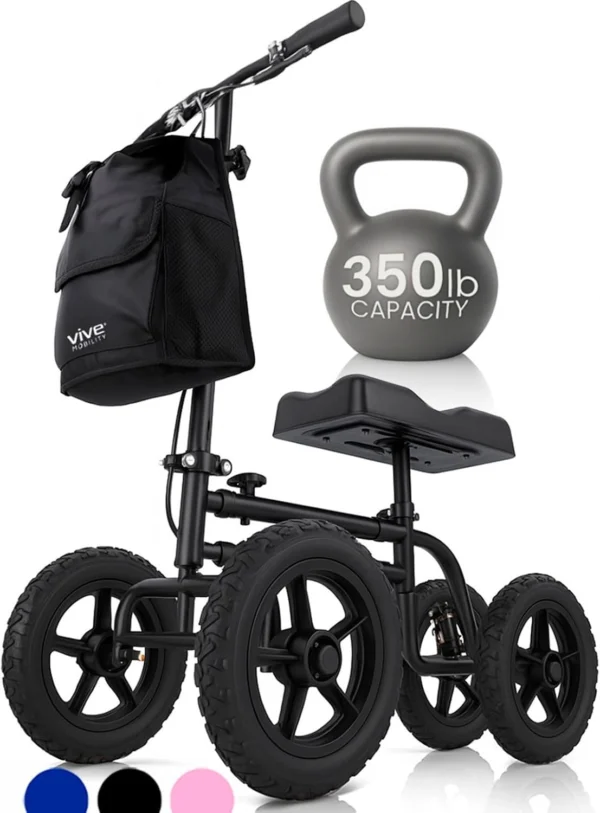
Vive Mobility All Terrain Knee Scooter
Features
- Weight capacity: 350 lbs
- Product weight: approximately 25 lbs
- Knee platform height: 20″ – 26″
- Handlebar height: 38″ – 46″
- Knee platform: 14″ x 7″
- Wheel size: 12″ pneumatic
- Frame: steel
- Foldable: yes
More features: four large pneumatic wheels; resilient foam knee platform; dual rear brakes; storage bag; folding frame.
The Vive All-Terrain Knee Walker is our best all-terrain choice because it combines four large 12-inch pneumatic wheels with a relatively manageable 25-pound frame. Vive rates it for users up to 350 pounds, giving it the same higher-capacity range as the premium KneeRover while maintaining a more conventional four-wheel layout.
Its 20–26-inch knee-platform adjustment and 38–46-inch steering-handle range also make this one of the taller scooters in the roundup. Those measurements are particularly important because an incorrectly fitted knee scooter can force the user into an awkward standing position.
What do we love it for?
The four 12-inch pneumatic tires provide a good balance between outdoor capability and stability. They should roll more comfortably over grass, uneven pavement and gravel than the 8-inch wheels fitted to most standard knee scooters.
The 350-pound capacity is another advantage. It gives larger users more choice without forcing them into a much heavier specialty model.
What could be better?
The large wheels make this a fairly substantial device, so it may feel cumbersome indoors or in small rooms. The high minimum handlebar and knee-platform settings also mean shorter users should check the dimensions carefully before purchasing.
As with any pneumatic-tire scooter, punctures and tire-pressure maintenance are potential drawbacks. A standard solid-wheel knee scooter is simpler if almost all use will be indoors.
6. Best Lightweight Standard Knee Scooter
Amazon
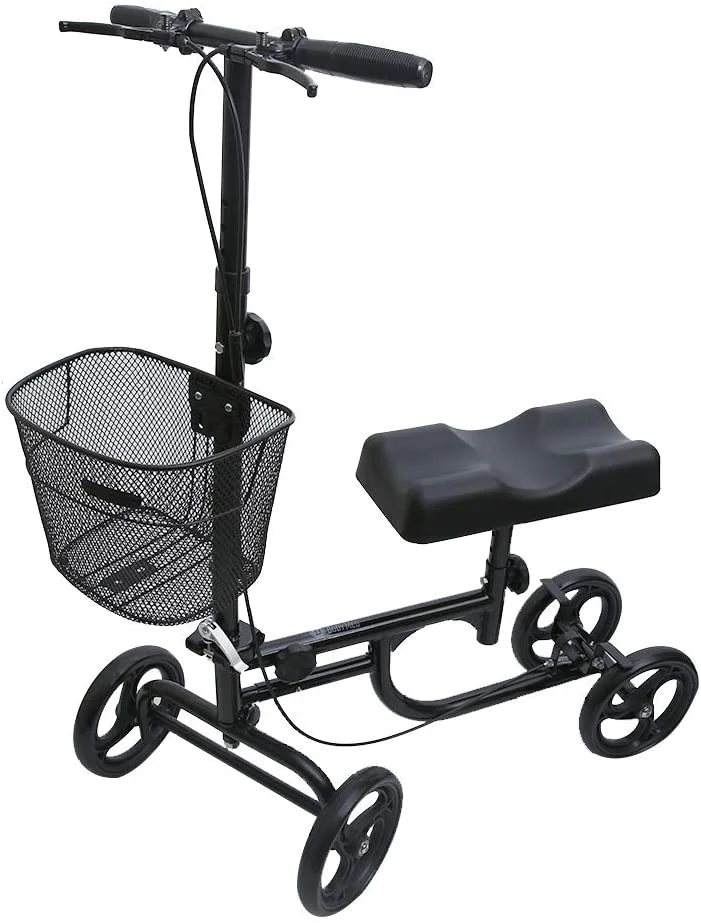
BodyMed Knee Walker
Features
- Weight limit: 300 lbs.
- Knee pad: 19” – 23”
- Handlebar height: 33” – 41”
- Tires: 7.8”
- Brake system: dual back
More features: padded contoured knee pad; washable knee pad cover; anti-slip grips
A BodyMed knee scooter is an excellent option for those who have recently suffered from foot surgery or a broken ankle. The adjustable knee pad was made specifically to provide users with ultimate comfort while walking on it, preventing any sort of pain in the joints. This particular model has a standard weight limit of 300 pounds and a knee pad height range of 19” – 23”, making it a good fit for most users.
This knee scooter is very different from other models on our list with its small size and light weight of only 20 pounds. Also, its wheels dimensions are unique compared to other knee scooters – 7.8 inches of the BodyMed vs. 8 and 12 inches of others. At the same time, the BodyMed features a detachable basket, as OasisSpace All-terrain and RinKmo.
What are our favorite features?
- We are into the padded contoured knee pad that ensures ultimate comfort while walking on it. Additionally, the washable knee pad cover is a great feature, as accidents do happen. The anti-slip grips prevent the scooter from sliding all over the place, making it a lot safer to use. Lastly, we appreciate the sleek and compact design that makes it easy to store and transport.
What could be better?
- Although we love most aspects of the BodyMed knee scooter, we feel a couple of downsides should be mentioned. Firstly, some users complain about the poor maneuverability of the scooter – specifically, that it doesn’t go in the direction they want it to. Secondly, the instructions on folding the handle are pretty vague, which can be a problem for people who have never used this model before.
Things to Consider
A knee scooter can provide a practical alternative to crutches for some people recovering from a foot, ankle or lower-leg injury when they have been instructed to keep weight off the affected limb. However, the suitability of a knee scooter depends on the injury, balance, strength, home environment and weight-bearing instructions given by your doctor or rehabilitation professional.
Research suggests that wheeled knee walkers can require less perceived effort than crutches for some users. In controlled studies, participants were generally able to move faster and with less perceived exertion using a knee walker, although much of this research involved healthy participants rather than people recovering from an actual injury.
Benefits of Knee Scooters
Knee scooters support the injured lower leg on a padded platform while the uninjured leg propels the scooter. This allows the user to remain mobile while following non-weight-bearing instructions for the affected foot or ankle, provided a knee scooter has been approved for their particular recovery.
They are not necessarily better than crutches for every person or every environment. Stairs, very uneven terrain, poor balance and some knee or hip conditions can all make another mobility aid more appropriate.
Less Reliance on the Hands and Arms
Crutches require substantial support through the hands and upper body, which can become tiring over longer distances. A knee scooter transfers much of the user’s support through the padded knee platform while the hands are primarily used for steering and braking.
This difference has been demonstrated in research. A study involving people with type 2 diabetes found considerably lower hand loading and perceived exertion when participants used a wheeled knee walker compared with crutches or a conventional walker.
Lower Perceived Effort for Some Users
One of the better-known studies comparing knee walkers with axillary crutches found that participants walked farther and faster while reporting lower perceived exertion with the knee walker. Importantly, the study involved 24 healthy volunteers on level surfaces, so the results should not be interpreted as proof that every injured user will find a knee scooter easier.
More recent research has reached broadly similar conclusions about energy requirements. Knee scooters have generally required less exertion than standard axillary crutches during level walking, although the difference varies with the activity and individual.
Easier Everyday Mobility
A knee scooter can make level-distance travel around a home, office, shopping center or similar environment considerably more practical for someone who cannot place weight through one foot. Storage baskets and bags are particularly useful because both hands should remain available to control the scooter.
The trade-off is that knee scooters require enough space to turn and cannot safely replace crutches in every situation. Stairs are an obvious example, and a plan may be needed for homes or workplaces that cannot be accessed entirely on one level.
Different Options for Different Environments
Standard knee scooters with small solid wheels work particularly well on smooth indoor floors and maintained pavement. Models with larger pneumatic or all-terrain wheels can offer better cushioning and roll more easily over cracks, grass and gravel.
That doesn’t make any knee scooter genuinely suitable for unrestricted off-road use. Stability, braking and the user’s ability to keep control become increasingly important as the surface becomes rougher or more sloped.
How to Choose the Best Knee Scooter
Choosing a knee scooter is less about finding the product with the longest feature list and more about matching the device to your body, recovery requirements and environment. Height adjustment, wheel size, weight capacity, braking and portability should all be considered before accessories or styling.
You should also confirm with your doctor, surgeon or physical therapist whether a knee scooter is appropriate for your particular weight-bearing restrictions. Some injuries and surgical procedures may require a different type of mobility aid.
Type
Most knee scooters fall broadly into standard, portable and all-terrain designs. Standard models use relatively small wheels and are generally best suited to homes, offices, shopping centers and maintained paved surfaces.
Portable models place greater emphasis on folding dimensions and transport. The KneeRover GO HYBRID, for example, is designed around a compact folding frame while still using larger pneumatic front wheels than a typical indoor scooter.
All-terrain models use substantially larger wheels to improve their ability to cross grass, gravel, pavement joints and other imperfect surfaces. They are usually heavier and bulkier, so the additional capability only makes sense if you will genuinely use it.
Adjustability and Fit
Both the knee platform and handlebars should adjust to suit the user’s height. The knee platform needs to support the injured leg without forcing the hips into an uneven or uncomfortable position, while the handlebars should allow an upright stance with enough control for braking and steering.
Adjustment ranges vary considerably between models, particularly with larger all-terrain scooters. Shorter and taller users should therefore compare actual knee-platform and handlebar measurements rather than assuming that every adult knee scooter will fit.
If you are unsure about the setup, ask your physical therapist or another qualified rehabilitation professional to check it. Correct fitting is particularly important when the scooter will be used for several weeks.
Knee Platform
The padded platform supports the lower leg while the scooter is moving, so its height, length, width and padding all affect comfort. A thick cushion may feel more comfortable initially, but the platform still needs to provide enough stability to keep the leg securely positioned.
Users recovering from knee problems should be particularly cautious because a knee scooter places sustained pressure through the bent knee and upper shin. A knee scooter intended to protect the foot or ankle may therefore be unsuitable when the knee itself is injured or cannot comfortably remain flexed.
Wheels
Wheel size is one of the easiest ways to decide between standard and outdoor-oriented knee scooters. Smaller 7- or 8-inch wheels keep a scooter compact and maneuverable indoors, while larger wheels generally pass over cracks and uneven surfaces more smoothly.
If outdoor walking is likely to form a substantial part of your recovery, the Vive Mobility All Terrain Knee Scooter uses large 12-inch pneumatic wheels specifically for this purpose. The trade-off is a larger overall scooter and the additional maintenance associated with air-filled tires.
Pneumatic tires can provide better cushioning but require pressure checks and can puncture. Solid wheels require less maintenance but generally transmit more vibration from rough surfaces.
Braking System
Most steerable knee scooters use hand-operated brake levers, similar in principle to bicycle brakes, which act on one or more rear wheels. The user should be able to comfortably reach and squeeze the brake while maintaining control of the handlebars.
Parking brakes or locking brake functions are also valuable when getting on or off the scooter. Always bring the scooter to a complete stop before changing position, and avoid relying on the brake to make steep slopes safe.
The old advice that a knee scooter can simply be used while travelling “up and downstairs” should be ignored. Do not ride a knee scooter on stairs. Follow your clinician’s advice for safely negotiating stairs using an appropriate alternative technique or mobility aid.
Weight Capacity
Most standard knee scooters in this roundup support approximately 300 pounds, while larger models increase capacity to around 350 pounds. Choose a scooter with a manufacturer-rated capacity appropriate for the user rather than assuming that a heavier-looking frame automatically supports more weight.
For users requiring additional capacity, the KneeRover QUAD All Terrain Knee Scooter is rated to approximately 350 pounds. Its larger frame and wheels make it more substantial than a typical indoor scooter, but also increase its carrying weight and storage requirements.
Weight capacity should be considered alongside physical dimensions. A scooter can technically support a user’s weight while still having a knee platform or overall geometry that is uncomfortable for their body size.
Scooter Weight
Product weight becomes particularly important when the scooter needs to be loaded into a vehicle several times a day. A difference of five or six pounds may not feel significant while riding but can be noticeable when lifting the device while also protecting an injured leg.
The BodyMed Knee Walker is the lightest conventional standard scooter in this lineup at approximately 20 pounds, while the bigger all-terrain models generally sit closer to the mid-20-pound range. The GO HYBRID is designed more around compact folded dimensions than being the absolute lightest product.
Foldability and Transport
Most of the knee scooters in this guide have folding handlebars or frames, but “foldable” does not necessarily mean small. Large wheels remain large after the handlebars have been folded, so compare actual folded dimensions if trunk space is limited.
If the scooter will regularly travel between home, work or medical appointments, think about how you will lift it as well as where it will fit. A model that is excellent to ride can still become frustrating if it is difficult to load into your vehicle.
Storage Basket or Bag
A basket or bag is more important on a knee scooter than it might initially appear. Because both hands should remain available for steering and braking, carrying a phone, drink, groceries or personal items by hand is impractical and may reduce control.
Several of the models in this guide include a detachable basket or storage bag, including the standard Vive, BlessReach and BodyMed. Avoid hanging heavy bags from the handlebars because additional weight in the wrong location can affect steering and balance.
Indoor vs Outdoor Use
If most of your recovery will take place inside a home, workplace or shopping center, a compact standard scooter such as the Vive Mobility Knee Walker or BodyMed Knee Walker is likely to be easier to maneuver than an all-terrain model. Their smaller wheels and shorter footprint generally require less turning space.
Outdoor users have different priorities. The BlessReach All-Terrain Knee Walker, KneeRover QUAD and Vive All-Terrain use larger wheels that are better suited to irregular surfaces, but they also require more space indoors and more effort to transport.
Price
Knee scooter prices vary substantially depending on brand, wheel size, construction and whether the model is designed for all-terrain use. Online pricing also changes frequently, so fixed price ranges can become outdated quickly.
It is generally better to decide what you actually need first and compare prices within that category. Paying extra for 12-inch pneumatic wheels makes sense if you regularly encounter grass or gravel, but it offers little benefit to someone whose recovery takes place almost entirely on smooth indoor floors.
Renting vs Buying
Because knee scooters are often needed only during a temporary recovery period, renting can make sense if you expect to use one for only a few weeks. Buying may be more economical over a longer recovery, particularly when the scooter will be used daily or when a specific adjustable or all-terrain model is required.
Check local medical-equipment suppliers as well as your health insurer before purchasing. Coverage and rental arrangements vary, and not every retail or Amazon purchase will qualify for reimbursement.
Knee Scooters FAQ
Can I Travel With My Knee Scooter?
Generally, yes, because many knee scooters fold sufficiently to fit into a vehicle. For air travel, however, policies differ between airlines and the scooter may need to be checked, gate-checked or handled as mobility equipment rather than treated like normal carry-on luggage.
Contact the airline before travelling and provide the scooter’s folded dimensions and weight if requested. Do not assume that the scooter will include a carrying bag, as many current models do not.
How Do I Fold My Knee Scooter Correctly?
There is no single folding procedure that applies to every knee scooter. Some models use a quick-release lever on the steering column, while others have different locking pins, clamps or folding mechanisms.
Follow the instructions for your exact scooter rather than forcing the handlebars down based on generic advice. Make sure the folding mechanism is fully locked again before using the scooter.
Is It Safe to Use a Knee Scooter on Uneven Surfaces?
It depends on the scooter, the surface and the user’s balance and experience. Large-wheel all-terrain models are better suited to grass, gravel and uneven pavement than small-wheel standard scooters, but no knee scooter should be assumed to be safe on every surface.
Slow down before cracks, curbs, slopes or transitions and avoid loose, steep or unstable terrain. Knee-scooter-related injuries do occur, so familiarity with the steering and braking system is important before travelling farther from home.
Are Knee Scooters Better Than Crutches?
Not universally, but some people find them easier to use on level surfaces. Studies comparing wheeled knee walkers with axillary crutches have found lower perceived exertion and better walking performance with the knee walker, and knee walkers have often been preferred by study participants.
However, crutches have advantages in situations where a scooter cannot be used, particularly stairs and very confined spaces. The correct device depends on the person’s injury, balance, upper-body ability and environment.
Can I Use a Knee Scooter After Foot or Ankle Surgery?
Knee scooters are commonly used during recovery when a patient has been instructed to remain non-weight-bearing through one lower limb. Whether one is suitable after your particular surgery should be decided by the clinician managing your recovery.
Do not use a knee scooter as a way of changing prescribed weight-bearing restrictions. Your surgeon or physical therapist should tell you when and how much weight can be placed through the injured foot.
Can Seniors Use Knee Scooters?
Age alone does not determine whether someone can safely use a knee scooter. Balance, coordination, strength, vision, reaction time and the ability to operate the brakes are more important considerations.
A senior who normally walks independently may find a knee scooter useful during temporary non-weight-bearing recovery, whereas someone with pre-existing balance difficulties may be safer using a walker, wheelchair or another prescribed mobility aid. If there is any uncertainty, a physical therapist or occupational therapist can assess the safest option.
Can I Sit on a Knee Scooter?
No. The padded platform is designed to support the knee and lower leg while the user stands on the uninjured leg; it is not a seat.
Sitting on the knee platform changes the scooter’s intended weight distribution and may make it unstable. If seated mobility is required, a wheelchair or purpose-designed seated mobility device is more appropriate.
Our Verdict
There is no single best knee scooter for every recovery. The right choice depends on whether you primarily need easy transport, indoor maneuverability, outdoor capability, higher weight capacity or a lighter frame.
Our KneeRover GO HYBRID is the standout option for portability because its compact folding design makes it easier to move between locations without restricting it entirely to indoor use. At the other end of the spectrum, the KneeRover QUAD All Terrain is the premium, more substantial choice for users who need larger wheels and a 350-pound capacity.
For normal everyday use, the Vive Mobility Knee Walker provides a good balance between maneuverability, adjustment and standard 8-inch wheels. The BlessReach All-Terrain Knee Walker offers larger wheels at the more value-focused end of the market, making it an interesting alternative for someone who wants more outdoor ability without moving directly to the premium KneeRover.
The Vive Mobility All Terrain Knee Scooter is our strongest dedicated all-terrain choice, combining four large pneumatic wheels with a 350-pound capacity. For users who expect mostly smooth indoor or paved surfaces and want to keep carrying weight down, the approximately 20-pound BodyMed Knee Walker is the better lightweight standard option.
Whichever model you select, make sure the knee platform and handlebars can be correctly adjusted and that you can confidently steer and brake the scooter before relying on it away from home. A knee scooter is designed primarily to help someone remain mobile while following prescribed weight-bearing restrictions; it is not a substitute for medical advice about when and how an injured limb can be loaded.
For people who require longer-term seated mobility rather than temporary non-weight-bearing support, our guide to mobility scooters for seniors covers a very different category of mobility equipment.
References
- Kocher BK, Chalupa RL, Lopez DM, Kirk KL. – Comparative Study of Assisted Ambulation and Perceived Exertion With the Wheeled Knee Walker and Axillary Crutches in Healthy Subjects. Foot & Ankle International. 2016;37(11):1232–1237.
In 24 healthy participants, the wheeled knee walker produced better assisted walking performance and lower perceived exertion than axillary crutches on level surfaces, and 88% of participants preferred the knee walker.
PubMed - Implications of Walking Aid Selection for Nonweightbearing Ambulation on Stance Limb Plantar Force, Walking Speed, Perceived Exertion, and Device Preference in Healthy Adults 50 Years of Age and Older.
In 21 adults aged over 50, a wheeled knee walker maintained walking speed with lower perceived exertion than crutches or a walker and was preferred by 20 of 21 participants.
PubMed - Hand Loading, Rates of Perceived Exertion, and Usability During Assisted Walking in Patients With Type 2 Diabetes Mellitus.
This study found substantially lower hand loading and perceived exertion with a wheeled knee walker compared with crutches and walkers in the study population.
PubMed - Canter DJ, et al. – A Comparison of Energy Expenditure and Perceived Exertion Between Standard Axillary Crutches, Knee Scooters, and a Hands-Free Crutch. PM&R. 2024;16(6):543–552.
During the six-minute walking test, the knee scooter produced the lowest energy expenditure, heart rate and perceived exertion among the three assistive devices tested in healthy participants.
PubMed - Knee Scooter-Related Injuries: A Survey of Foot and Ankle Orthopedic Surgeons.
This study documents that injuries associated with knee-scooter use do occur, reinforcing the need for appropriate user selection, instruction and cautious use.
PubMed